
DOJ Admits It Has a Policy of Waiving Time Bars in Illegal Sentence Cases. So Why Does It Almost Never Follow It?
The Department of Justice just made one of the most important admissions I’ve seen in years in federal post-conviction litigation.
Buried inside a Supreme Court filing in Lairy v. United States, No. 25-821, the government admitted that it has a policy of waiving statute-of-limitations and procedural-bar defenses when a prisoner is serving an illegal enhanced sentence above the lawful statutory maximum.
Here’s the exact quote from the DOJ’s Supreme Court brief opposing cert:
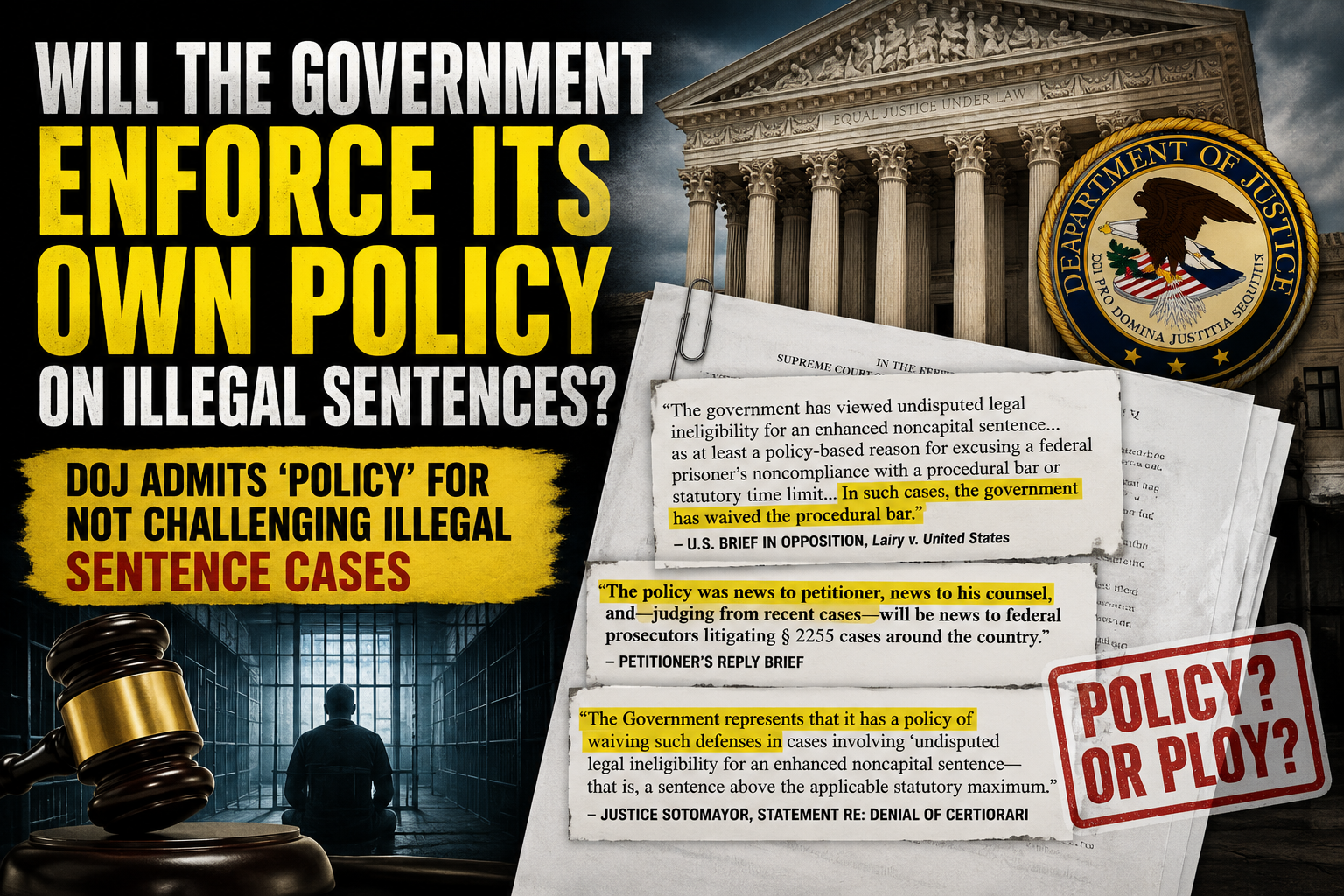
“The government has viewed undisputed legal ineligibility for an enhanced noncapital sentence—that is, a sentence above the applicable statutory maximum—as at least a policy-based reason for excusing a federal prisoner’s noncompliance with a procedural bar or statutory time limit on a claim for postconviction relief under 28 U.S.C. § 2255. In such cases, the government has waived the procedural bar.”
Read that again. The DOJ told the Supreme Court that when someone is serving an unlawful enhanced sentence, the government has a policy of waiving procedural defaults and time bars.
Then the DOJ admitted that “it inadvertently did not do so here.”
According to the DOJ, prosecutors supposedly forgot to follow this policy in Lairy’s case. That claim immediately raised eyebrows because federal prisoners see the exact opposite happen every day.
Does This Policy Really Exist?
Despite what the government said here, prosecutors routinely fight § 2255 motions on procedural grounds even when the sentence enhancement is clearly illegal. And Lairy’s lawyers called the government out on this. In their Supreme Court reply brief, they wrote:
“The Government characterizes its policy as preexisting, but the policy was news to petitioner, news to his counsel, and—judging from recent cases—will be news to federal prosecutors litigating § 2255 cases around the country.”
And then they added: “The policy appears nowhere in any regulation, manual, or public guidance identified by the Government.”
The defense basically accused the DOJ of suddenly inventing a “policy” only after the case reached the Supreme Court that would have created favorable precedent for prisoners nationwide. And the defense lawyers backed that up by pointing to other recent cases where prosecutors were still aggressively asserting procedural bars in illegal sentence cases: “In several cases decided in just the past few months, the Government has asserted procedural-bar defenses that it should have waived pursuant to its policy.”
That means one of two things is true:
- The DOJ really does have this policy, and federal prosecutors around the country are ignoring it.
OR
- The DOJ made representations to the Supreme Court that do not reflect what prosecutors actually do in real § 2255 litigation.
Most likely it’s both.
The Supreme Court Says the Policy Exists
Justice Sotomayor issued a public statement respecting denial of certiorari and repeated the DOJ’s claimed policy in the official Supreme Court order. She wrote:
“The Government represents that it has a policy of waiving such defenses in cases involving ‘undisputed legal ineligibility for an enhanced noncapital sentence—that is, a sentence above the applicable statutory maximum.’”
That matters. This is no longer buried in some obscure government filing. A United States Supreme Court Justice publicly acknowledged the government’s claimed policy in an official Supreme Court order. Though not binding on any court, it gives prisoners something real to cite.
Why This Matters for Prisoners
This case could become extremely important in:
- ACCA cases
- Career offender cases
- § 851 enhancement cases
- illegal mandatory minimum cases
- guideline enhancement litigation tied to statutory maximums
Prisoners now have ammunition if the government tries to argue:
- statute of limitations
- procedural default
- untimeliness
- waiver
I suspect the DOJ wanted to avoid a major Supreme Court ruling. The actual issue in Lairy was whether “actual innocence” applies to illegal sentence enhancements. If the Supreme Court had ruled for Lairy, it could have opened the door for thousands of prisoners serving unlawful sentences to bypass procedural barriers.
Instead, the DOJ sidestepped the issue by suddenly announcing this supposed policy and waiving the defense after the case reached the Supreme Court. And that may end up backfiring. Because now prisoners know about the policy. And now the DOJ may have to explain why prosecutors almost never seem to follow it.

Dale Chappell prepares people in sensitive, high-profile, and high-stakes federal cases for prison. He works with clients, families, and attorneys during pretrial, throughout incarceration, and during the transition to halfway house placement, home confinement, and supervised release.
Dale brings more than 17 years of experience, firsthand knowledge of the federal prison system, and experience testifying at high-profile public hearings on prison and criminal justice issues. He helps clients protect their safety and privacy, avoid decisions that can follow them throughout their sentences, and prepare for the strongest possible outcome at every stage.
Dale has written nearly 600 published articles on federal prison, post-conviction, and criminal justice issues.
Have questions?
Email Dale directly at dale@dale-chappell.com.
Leave a Reply