
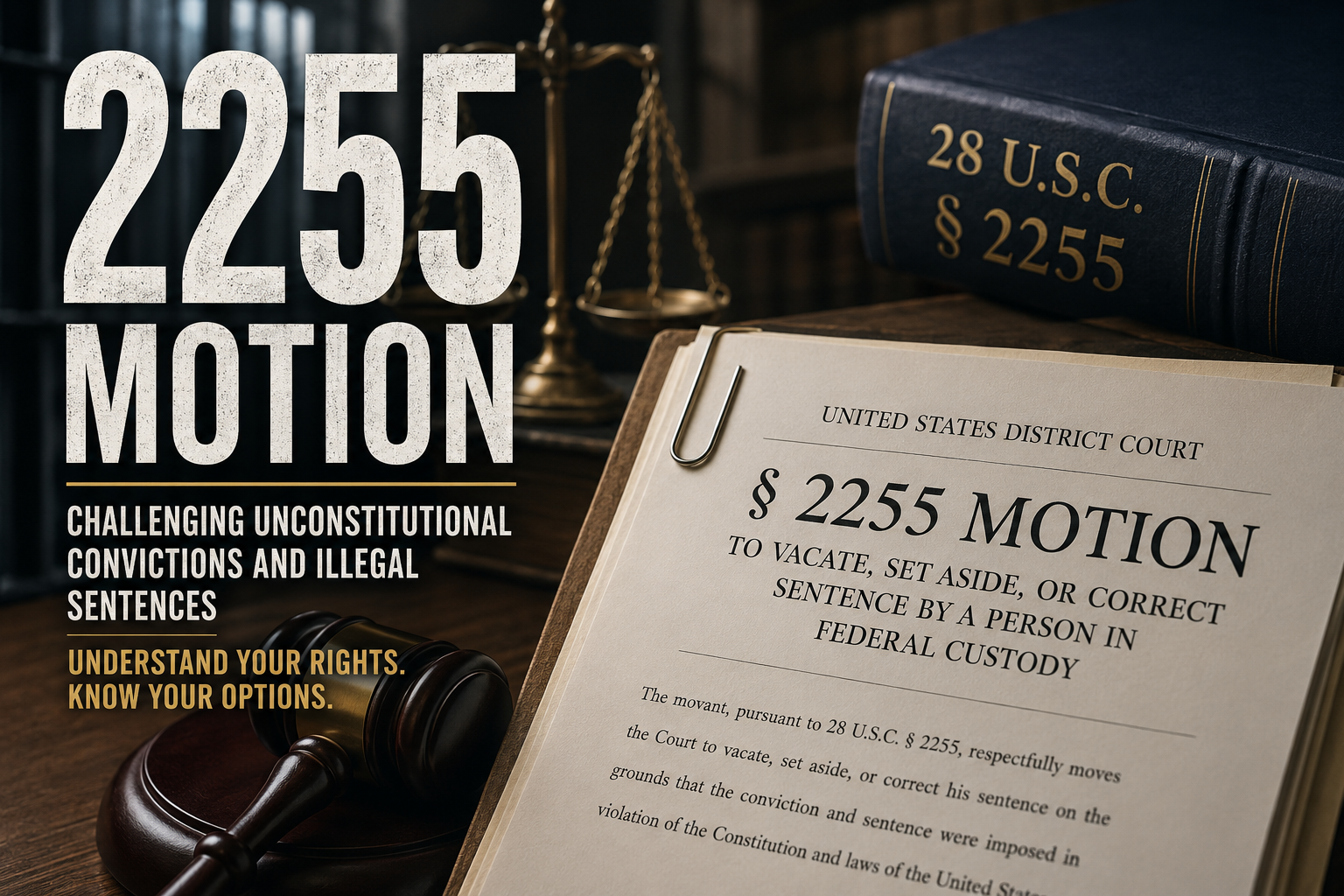
A Motion to Vacate Judgment Under 28 U.S.C. § 2255
Most people think a federal criminal case ends after sentencing and appeal. It doesn’t.
After the appeal process is over, a federal prisoner may still be able to challenge the conviction or sentence through what’s called a motion under 28 U.S.C. § 2255, usually shortened to simply a “2255 motion.”
People are often talking about the same thing, if you’ve heard terms like:
- habeas corpus
- collateral attack
- post-conviction relief
- federal habeas
- ineffective assistance of counsel
A § 2255 motion is the primary way federal prisoners challenge unconstitutional convictions, illegal sentences, and fundamentally unfair proceedings after the direct appeal process has ended. Congress created it in 1948 as a replacement for traditional habeas corpus proceedings filed by federal prisoners.
But there’s a lot of confusion about what a 2255 motion actually is, and what it is not.
Here, we break it down in plain English without oversimplifying it.
What Is a 2255 Motion?
A § 2255 motion is a federal post-conviction remedy that allows a federal prisoner to challenge the legality of a conviction or sentence after the criminal case becomes final.
In simple terms, it is a way to argue:
- the conviction violated the Constitution,
- the sentence was illegal,
- the court lacked authority,
- counsel was ineffective,
- or the entire proceeding was fundamentally unfair.
The Supreme Court described § 2255 as an “independent and collateral inquiry into the validity of the conviction.” That word “collateral” is important.
A direct appeal challenges errors during the criminal case itself. A collateral attack challenges the validity of the conviction after the normal review process has ended. It’s a challenge to the criminal case, but with a different focus than an appeal.
Why Congress Created § 2255
Before § 2255 existed, federal prisoners filed traditional habeas corpus petitions in the district where they were imprisoned. That became a logistical nightmare.
Most federal prisons were located in only a handful of districts, meaning those courts became flooded with habeas petitions from prisoners sentenced all over the country. Congress responded by creating § 2255 in 1948 and requiring prisoners to file these challenges in the sentencing court instead.
The idea was simple:
- the sentencing judge already knew the case,
- the records were already there,
- witnesses and attorneys were easier to access,
- and it was more efficient than transporting everyone to the prison district.
The Supreme Court later explained that the purpose of § 2255 was to provide federal prisoners with essentially the same remedy as habeas corpus, just in a more convenient forum.
A 2255 Motion Is NOT a Second Appeal
This is one of the biggest misconceptions. A § 2255 motion is not simply another chance to argue everything that already lost on appeal.
Federal courts repeatedly say: “Section 2255 is not a substitute for direct appeal.”
That means many issues that could have been raised earlier are barred later. For example:
- ordinary evidentiary disputes,
- disagreements with trial strategy,
- or routine legal arguments
usually belong on direct appeal, not in a § 2255 motion.
But some claims are different.
A § 2255 motion often focuses on issues that:
- were hidden,
- outside the record,
- unknown at the time,
- or impossible to properly raise on direct appeal.
That’s why ineffective assistance of counsel claims are so common in § 2255 litigation.
What Kinds of Claims Can Be Raised in a 2255 Motion?
Section 2255 itself lists four general categories of claims.
The Most Common 2255 Claim: Ineffective Assistance of Counsel
Most successful § 2255 motions involve ineffective assistance of counsel, commonly called “IAC.”
The Sixth Amendment guarantees not just a lawyer, but the effective assistance of counsel. That does not mean every losing lawyer was ineffective. Courts give lawyers a lot of deference.
But some attorney errors are so serious they undermine confidence in the outcome of the case. Examples include:
- giving incorrect plea advice,
- failing to investigate,
- missing obvious suppression issues,
- failing to object to illegal sentence enhancements,
- failing to file an appeal,
- misunderstanding sentencing law,
- or failing to properly advise about immigration or collateral consequences.
The Supreme Court’s Strickland standard generally requires showing:
- deficient performance, and
- prejudice.
In plain English:
- the lawyer performed unreasonably,
- and the mistake mattered.
One major reason IAC claims are raised in § 2255 motions instead of direct appeal is because they often require evidence outside the trial record:
- emails,
- letters,
- attorney notes,
- plea discussions,
- missing investigations,
- or conversations never placed on the record.
That is exactly the type of factual development collateral review is designed for.
The Court Lacked Jurisdiction
Jurisdictional claims are less common but still important. This usually means:
- the court lacked legal authority,
- the indictment failed to state a federal offense,
- or some structural problem made the conviction invalid.
These claims are often misunderstood. Just because someone says “jurisdiction” does not mean they automatically win.
The Sentence Exceeded the Legal Maximum
This includes situations where:
- a sentence was illegally enhanced,
- the wrong mandatory minimum was used,
- the wrong statute applied,
- or later Supreme Court decisions changed the legality of the sentence.
This became especially important after Supreme Court decisions ruled portions of sentencing statutes unconstitutional in recent years.
Fundamental Miscarriages of Justice
This is the catch-all category. Courts describe this as:
- “fundamental defects”
- resulting in a
- “complete miscarriage of justice.”
This category can include:
- actual innocence,
- unlawful mandatory sentencing schemes,
- invalid prior convictions,
- or proceedings so fundamentally unfair they undermine confidence in the outcome.
Not every unfair result qualifies. Federal courts apply very demanding standards here.
What a 2255 Motion Can Actually Do
A lot of people assume winning a § 2255 motion means immediate release. Not necessarily.
If the court grants relief, it has several options. The court can:
- vacate the conviction,
- order a new trial,
- resentence the defendant,
- correct the sentence,
- or restore appeal rights.
Sometimes a person walks free. Sometimes the government retries the case. Sometimes the court simply conducts a new sentencing hearing. Sometimes the result is only a reduced sentence instead of a full vacatur.
Every case is different.
A 2255 Motion Has Strict Time Limits
This is where many people get denied. In most cases, a federal prisoner has one year to file a § 2255 motion after the criminal judgment becomes final and appeals are finished.
There are some exceptions involving:
- newly discovered evidence,
- new Supreme Court decisions,
- or government interference,
but the general rule is one year. And that deadline matters. A strong claim filed late can still lose.
What Families Need to Understand
One of the biggest problems in federal post-conviction work is that families often do not realize:
By the time many people start researching § 2255 motions:
- deadlines are close,
- appeal waivers are misunderstood,
- lawyers are gone,
- records are missing,
- and procedural mistakes have already happened.
Worse, prisoners often rely on jailhouse advice that mixes truth with complete nonsense. Understanding what a § 2255 motion actually is helps families:
- ask better questions,
- identify real issues,
- avoid scams,
- and recognize when serious constitutional problems may exist.
How Long Does a 2255 Motion Take?
When people ask how long a § 2255 motion takes, my usual answer is that a proper § 2255 case is like a long-term relationship. Most of them take many months or even years, though the process can be expedited in some cases.
The reason it is such a long process is because there are four general stages to a § 2255 case:
- The initial motion
- The government’s response
- The reply to the government’s response
- The court’s decision
Add into that the need for any supplemental filings, further replies and responses ordered by the court, and any hearings, and you can see why these cases are complicated.
Why So Many 2255 Motions Fail
Most § 2255 motions fail. Not because every conviction was fair, but because federal post-conviction standards are extremely difficult. Common reasons motions fail include:
- weak claims,
- conclusory allegations,
- procedural defaults,
- missed deadlines,
- poor drafting,
- misunderstanding the law,
- or raising issues that are not legally cognizable.
Courts also screen § 2255 motions very early under Rule 4 of the Rules Governing Section 2255 Proceedings. If the court believes it “plainly appears” the prisoner is not entitled to relief, the motion can be dismissed immediately without even requiring a government response.
That is why serious post-conviction litigation is far more complicated than many people realize.
Common Myths About 2255 Motions
- “Any error can be raised.”
False. Only certain categories of claims qualify.
- “My lawyer lost, so he was ineffective.”
Not necessarily. The legal standard is much higher than simply losing.
- “The judge has to hold a hearing.”
No. Many motions are dismissed without hearings.
- “You can keep filing unlimited motions.”
Absolutely false. Federal law severely restricts second or successive § 2255 motions.
In most situations, you effectively get one full opportunity.
- “If the appeal lost, the case is over.”
Not always. Some of the strongest claims:
- ineffective assistance,
- Brady violations,
- sentencing errors,
- and unconstitutional statutes
often emerge after appeal.
2255 vs. Other Federal Remedies
People often confuse different remedies. A § 2255 motion is different from:
- a direct appeal,
- compassionate release,
- a Rule 33 new trial motion,
- a § 2241 petition,
- or sentence reduction proceedings.
Each remedy serves a different purpose.
A § 2255 motion specifically challenges the legality of the conviction or sentence itself.
Final Thoughts
A § 2255 motion is often the last meaningful opportunity to challenge a federal conviction or sentence.
But it is not magic. It is not simple. And it is not just “another appeal.”
Federal post-conviction litigation is a specialized area of law involving constitutional principles, procedural barriers, sentencing law, and evolving Supreme Court doctrine. Strong claims can fail if raised incorrectly. Weak claims can permanently block future litigation.
That is why understanding what a § 2255 motion actually is, and what it is not, matters so much.
For many federal prisoners and their families, learning how collateral review works is the first real step toward determining whether meaningful relief may still be possible.

Dale Chappell works with individuals, families, and attorneys on sensitive and high-profile federal cases, focusing on prison preparation, housing, and post-conviction strategy. He supports clients and legal teams with research, issue analysis, and drafting used in federal post-conviction matters, including § 2255 motions, appeals, sentence reductions, and related filings.
His work is based on nearly 17 years of experience and more than 450 published articles in legal publications focused on post-conviction relief. His focus is helping clients and their families understand how the system actually works and avoiding preventable mistakes.
Have questions?
Email Dale directly at dale@dale-chappell.com.
Leave a Reply