
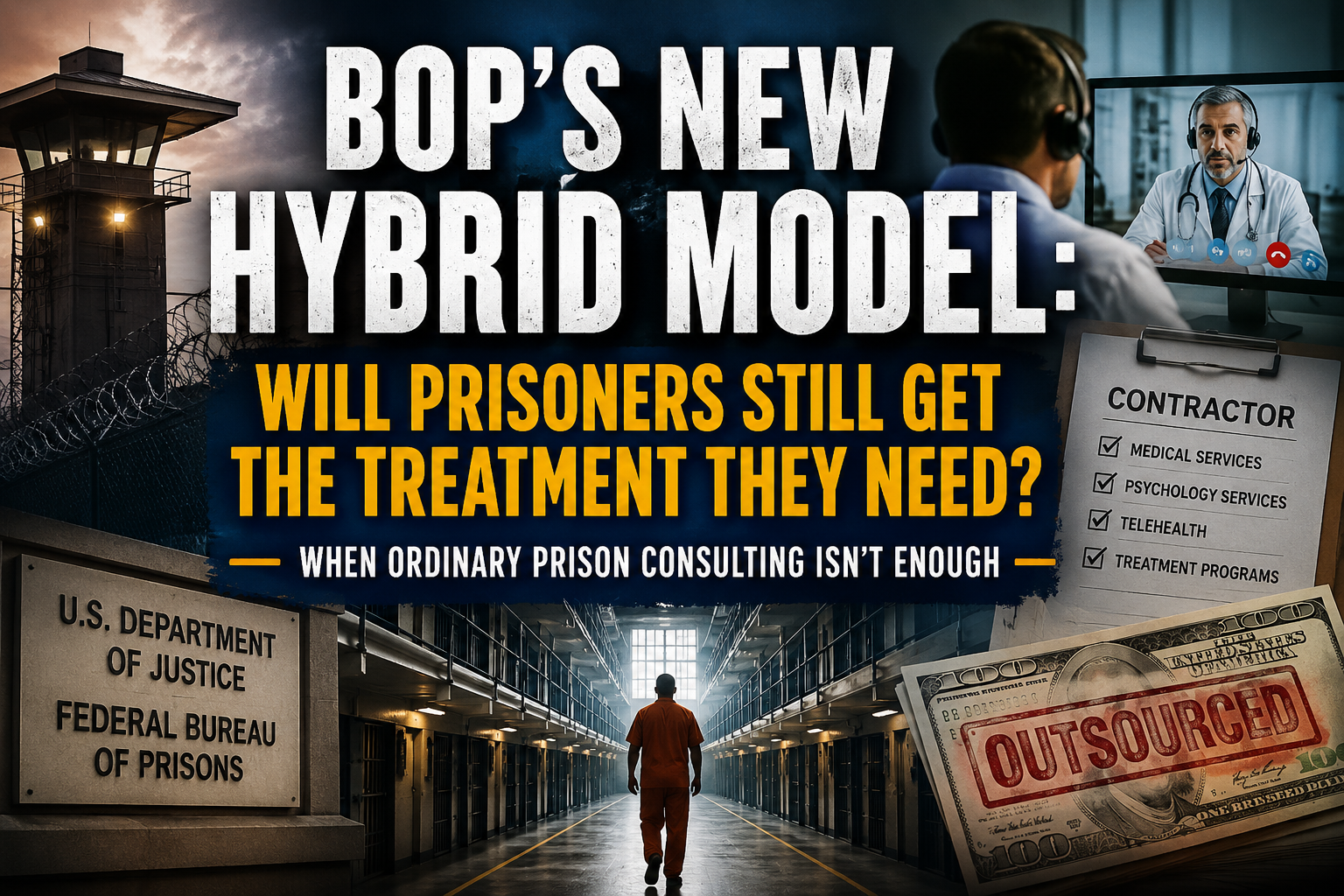
The Federal Bureau of Prisons is asking Congress for more than $10.3 billion for fiscal year 2027. (read the budget request here)
The agency says the money will improve staffing, medical care, psychology services, programming, technology, reentry, and institutional safety. But the BOP’s budget request must be considered alongside its apparent move toward a hybrid prison system that relies increasingly on private contractors, telehealth providers, technology vendors, and outsourced services.
That may help the BOP keep prisons operating. But it raises a much more important question:
Will prisoners receive the medical care and psychological treatment they actually need, especially as the federal prison population becomes older and more treatment-dependent?
That question is particularly important for people serving sentences for sex offenses.
The BOP’s Sex Offender Population Is Growing and Aging Inside Prison
Current BOP statistics show that people incarcerated for sex offenses now make up the third-largest offense group in federal prison.
BOP statistics currently show:
- Drug offenses: 61,118 prisoners, or 42.6%
- Weapons, explosives, and arson: 31,756 prisoners, or 22.1%
- Sex offenses: 20,550 prisoners, or 14.3%
Sex offenses now account for more federal prisoners than immigration, fraud, robbery, homicide, burglary, and every other offense category except drugs and weapons.
That alone should get Congress’s attention. But the number of sex offender prisoners does not tell the whole story.
Drug and firearm cases have traditionally involved many younger defendants. Even after serving substantial sentences, some still leave prison young enough to work, rebuild family relationships, and establish a new life.
Sex offense cases are different.
Many people in federal sex offense cases enter custody at an older age than defendants in drug and gun cases. They also frequently receive sentences measured in decades. That means they are not simply passing through the prison system. They are aging inside it.
The BOP is therefore facing more than a population problem. It is facing an expanding long-term medical and psychological-care problem.
Long Sentences Create Long-Term Medical Costs
An aging prison population requires more care. Older prisoners are more likely to need treatment for:
- Cancer
- Heart disease
- Diabetes
- Chronic pain
- Mobility problems
- Neurological conditions
- Dementia and cognitive decline
- Serious mental-health conditions
- Medication management
- Outside specialty care
These needs do not become cheaper because the person is incarcerated.
In many cases, prison makes the cost higher. Outside medical trips require transportation, correctional officers, security planning, overtime, and coordination with community hospitals. A condition that could have been treated early may become an emergency because of delays in diagnosis or referrals.
The BOP already acknowledges that medical staffing shortages limit access to care, increase the need for outside treatment, raise costs, and create safety problems. Its FY 2027 budget projects approximately $1.66 billion in medical spending and almost $388 million for Psychology Services. The same budget says about 20% of the population is over age 50 and approximately 45% of prisoners have multiple chronic conditions.
Those costs will not shrink while the BOP continues incarcerating a growing population of older people serving very long sentences.
The system is aging into a crisis it is not prepared to handle.
The BOP’s Proposed Answer Is a Hybrid Model
Instead of rebuilding a fully staffed system of federal medical professionals, psychologists, treatment specialists, and program providers, the BOP appears to be moving toward a hybrid structure.
Federal employees would continue operating institutions and maintaining security. But more medical care, psychology services, treatment, telehealth, reentry, technology, and community placement could be handled by contractors and outside providers.
The FY 2027 request includes:
- $454.7 million for a Staffing Investment Plan
- $106.9 million for expanded contract reentry capacity
- $81.7 million for a new electronic medical-record system
- $46 million for off-site mail scanning and attorney-client email
- $40.3 million for information-technology modernization
- $32.4 million to activate the new Leavenworth institution
- $4 million for expanded telehealth
The BOP is asking for hundreds of millions of dollars to stabilize staffing and modernize operations. But the spending plan does not amount to a major expansion of doctors, psychologists, treatment specialists, educators, and counselors working directly with prisoners.
At the same time, the agency has explored outsourcing health care, psychology services, food service, commissary operations, and other functions.
Jack Donson raised this concern in “BOP Explores Privatization on Multiple Fronts,” published by the Federal Prison Education and Reform Alliance, or PERA, a nonprofit organization that works with justice professionals, incarcerated people, and families to address barriers to rehabilitation and release, shortcomings in care, and abuses within the federal prison system.
Donson questioned how the BOP can expect to recruit and retain qualified medical and psychology professionals while signaling that those same services may eventually be handed to contractors.
That contradiction goes to the heart of the problem.
The BOP may be rebuilding prison operations. That does not mean it is rebuilding rehabilitation or medical care.
Outsourcing Care Does Not Eliminate the Need
Privatization does not make an aging population healthier.
It does not reduce the number of prisoners who need cancer treatment, cardiac care, mobility assistance, medication, psychological services, or specialized treatment. It only changes who is responsible for providing those services.
Private correctional health-care systems have repeatedly been criticized for familiar problems:
- Too few clinicians
- High staff turnover
- Delayed treatment
- Limited outside referrals
- Poor continuity of care
- Incomplete medical records
- Cost-cutting that affects treatment decisions
- Government agencies and contractors blaming each other
A contractor must provide services for less than the amount of the contract to earn a profit. That creates pressure to control staffing, limit expensive services, and reduce outside treatment.
Those incentives are dangerous when dealing with an aging prison population.
They are even more concerning when psychological assessments and treatment records can affect how a person is managed, released, and supervised.
Psychology Services Are Central to Sex Offender Cases
For sex offense prisoners, Psychology Services is not a minor part of incarceration.
BOP psychologists may be involved in:
- Initial psychological screening
- Mental-health treatment
- Suicide prevention
- Crisis intervention
- Risk and needs assessments
- Sex Offender Management Programs
- SOTP-R and SOTP-NR
- Treatment recommendations
- Community-treatment referrals
- Release planning
- Civil-commitment reviews
The BOP’s budget describes SOMP as including treatment, assessment, specialized correctional management, and population management. It identifies SOTP-R as the higher-intensity residential program and SOTP-NR as the moderate-intensity program frequently serving first-time internet offenders.
These services require more than a contractor appearing by video for a short appointment.
Effective treatment requires continuity, accurate records, qualified clinicians, sufficient time, and an understanding of the individual prisoner.
A rushed assessment or careless treatment note can follow someone for years. It may affect institutional placement, treatment eligibility, probation decisions, community-treatment requirements, supervised-release conditions, and possible civil-commitment review.
The BOP cannot claim to be serious about reducing recidivism while weakening or fragmenting the very psychology services that manage one of its largest and fastest-growing populations.
Cutting Treatment Will Cost More Later
Outsourcing medical and psychology services may appear less expensive in a budget proposal.
But inadequate treatment creates costs elsewhere.
Delayed medical care leads to emergencies, hospitalization, outside treatment, litigation, disability, and higher long-term expenses.
Inadequate psychological treatment creates its own costs. People may leave prison without understanding their risk factors, without completing necessary treatment, without a stable community-care plan, and without records showing meaningful progress.
Those failures can lead to:
- More restrictive supervision
- More intensive treatment after release
- Greater difficulty finding approved housing
- Employment problems
- Supervision violations
- Revocation and return to prison
- Higher recidivism risk
The BOP may save money in one budget category only to spend more through emergency medical care, community treatment, supervision enforcement, revocation proceedings, and reincarceration.
That is not cost savings. It is shifting the bill into the future.
A Program on Paper Is Not Treatment
The BOP regularly points to its approved programs and specialized services.
But the existence of a program does not mean a prisoner can actually receive it. A program may be listed as available while:
- The psychologist position is vacant
- The contractor cannot fill clinical positions
- The waiting list extends beyond the prisoner’s release date
- Staff are reassigned to correctional posts
- Lockdowns repeatedly cancel treatment
- Referrals are delayed
- Local administrators impose additional requirements
- The prisoner is transferred before completing the program
The BOP can tell Congress that a program exists while prisoners wait years to enter it.
That distinction becomes critical for sex offense prisoners serving long sentences. The system may use the length of the sentence to delay treatment until the final years, only for staffing shortages, transfers, or waiting lists to prevent meaningful completion.
The BOP then releases the person with less treatment than the sentencing court, probation office, family, and community expected.
The Sentencing Consequences
This problem begins at sentencing.
Under 18 U.S.C. § 3553(a)(2)(D), federal courts consider the need to provide the defendant with educational or vocational training, medical care, or other correctional treatment in the most effective manner.
Judges frequently recommend mental-health treatment, sex-offender treatment, substance-use treatment, education, vocational training, or other programming.
The court may impose a sentence believing those services will help prepare the person for release.
But a recommendation from the judge does not guarantee that the BOP will provide the treatment.
The person may enter an institution where the program is understaffed, delayed, outsourced, or unavailable. The prison sentence still gets served. The treatment may not.
That creates a gap between what the sentencing court expected and what the prisoner actually receives.
The Consequences Continue on Supervised Release
When treatment does not happen in prison, the problem moves directly into supervised release.
A person may leave custody without completing the treatment the judge expected, without a coordinated community-treatment plan, and without records demonstrating progress.
For sex offense clients, release may already involve:
- Mandatory treatment
- Polygraph examinations
- Internet and device restrictions
- Contact restrictions
- Registration obligations
- Housing limitations
- Employment barriers
- Intensive probation oversight
A person who received little meaningful preparation inside prison may suddenly be expected to manage all of these requirements in the community.
Probation may view the lack of treatment as evidence that more restrictions are necessary, even when the failure resulted from the BOP’s lack of access rather than the person’s refusal to participate.
When that person struggles, violates supervision, or returns to prison, the system blames the individual.
It rarely admits that the treatment and preparation contemplated at sentencing never occurred.
Extreme Sentences Created This Problem
This is what happens when sentencing policy is driven by fear instead of evidence.
Decades-long sex offense sentences do not eliminate costs. They postpone and multiply them.
A person who enters prison in middle age, as sex offense defendants often do, may eventually require years of chronic medical care, medication, mobility assistance, mental-health services, and specialized housing. Those costs continue long after any realistic public-safety benefit of incarceration may have diminished.
Congress and the courts cannot keep imposing extreme sentences and then act surprised when the prison system becomes a long-term medical-care system for aging prisoners.
At some point, the government must confront the connection between sentencing policy and prison costs.
The BOP’s hybrid model does not solve that problem. It may simply hide it behind contracts.
Why Ordinary Prison Consulting Isn’t Enough
Ordinary prison consulting often focuses on surrender, security level, geographic designation, and placement.
Those issues matter. But for sex offense and other sensitive cases, they are only the beginning.
A client and attorney also need to understand:
- What treatment the sentencing court expects
- Whether the recommended treatment is realistically available
- Which institutions have functioning psychology programs
- Whether the client is likely to qualify
- How long the waiting list may be
- Whether contractors are providing the services
- What psychological and medical records will be created
- How those records may affect release and supervision
- What to do when treatment is delayed or denied
- How to prepare for release when the BOP fails to provide adequate preparation
A facility can look appropriate on paper and still be a terrible placement if its psychology department is understaffed, its treatment program is inactive, or its medical system cannot handle the client’s long-term needs.
The growing sex offender population in the BOP makes these questions more urgent. These prisoners are serving long sentences, aging inside the system, and facing complicated treatment and supervision requirements.
The BOP is sending conflicting messages about how it plans to care for them.
Defendants, families, and attorneys cannot rely on program lists, press releases, or budget promises. They need to understand how the BOP’s changing system is likely to affect the individual client from sentencing through incarceration and into supervised release.
That is why ordinary prison consulting isn’t enough.

Dale Chappell prepares people in sensitive, high-profile, and high-stakes federal cases for prison. He works with clients, families, and attorneys during pretrial, throughout incarceration, and during the transition to halfway house placement, home confinement, and supervised release.
Dale brings more than 17 years of experience, firsthand knowledge of the federal prison system, and experience testifying at high-profile public hearings on prison and criminal justice issues. He helps clients protect their safety and privacy, avoid decisions that can follow them throughout their sentences, and prepare for the strongest possible outcome at every stage.
Dale has written nearly 600 published articles on federal prison, post-conviction, and criminal justice issues.
Have questions?
Email Dale directly at dale@dale-chappell.com.
Leave a Reply