
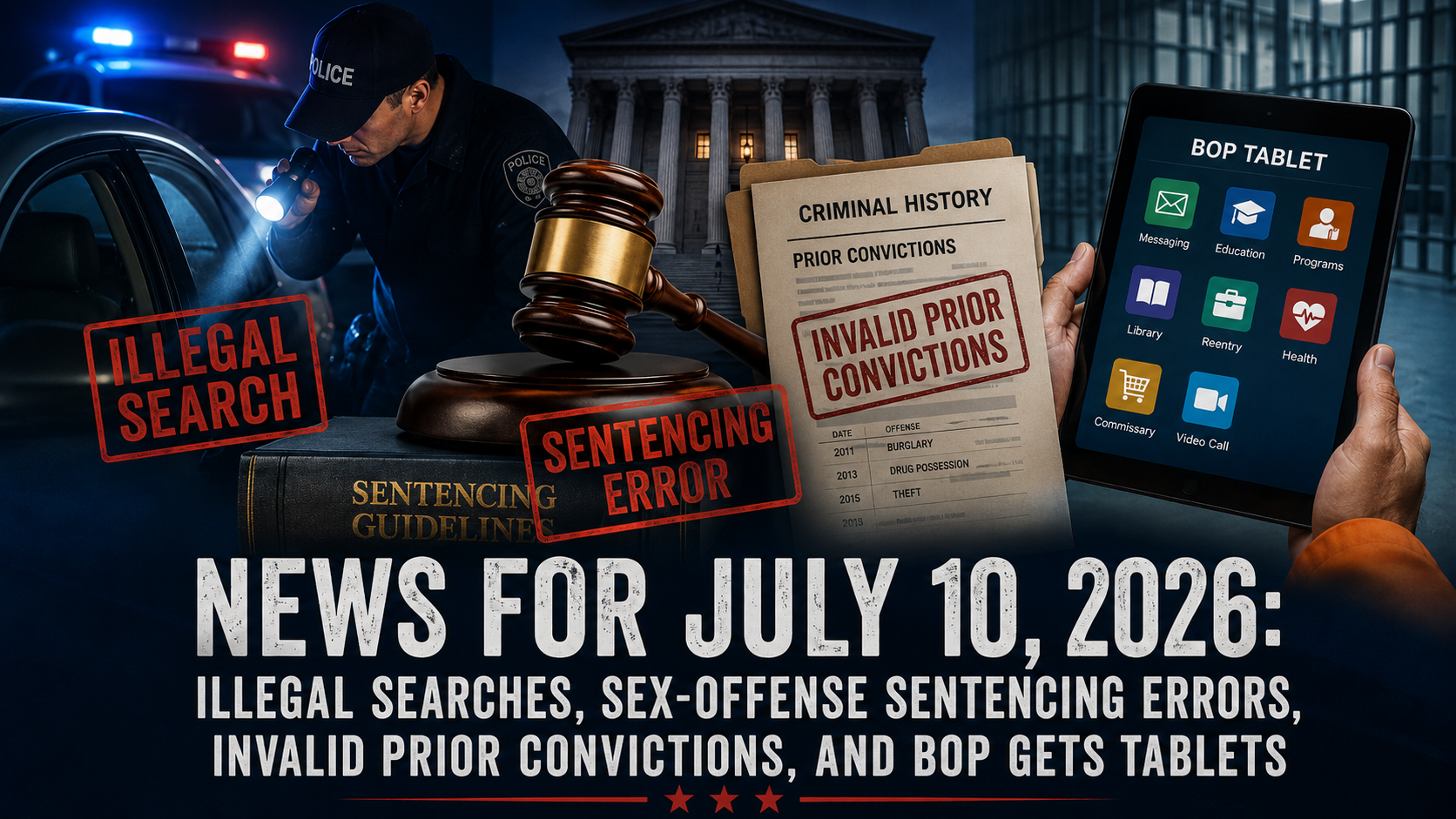
This week’s newsletter covers several favorable federal court decisions and developments affecting sentencing, convictions, and post-conviction relief. As always, the goal is to keep readers informed about important legal rulings that may impact ongoing cases, appeals, and future challenges in federal court.
United States v. Martinez, 2026 U.S. App. LEXIS 19808 (7th Cir. July 7, 2026)
Administrative Truck Inspection Could Not Be Used as a Pretext for a Drug Investigation
The Seventh Circuit reversed the denial of Ausencio Martinez’s motion to suppress because the district court applied the wrong rule when evaluating the purpose of the traffic stop. Officers received a drug-trafficking tip, selected Martinez’s specific truck because they suspected it contained narcotics, assigned two K-9 officers to wait for it, and then stopped it under the claimed authority of a commercial-trucking inspection program. The district court held that the officer’s actual purpose did not matter so long as Illinois law objectively authorized administrative inspections. The Seventh Circuit held that this was error because administrative inspections are an exception to the ordinary rule that an officer’s subjective intent is irrelevant. An administrative-inspection program cannot be used as a substitute for the individualized suspicion required for a criminal investigation. Because the evidence showed that the inspection may have been a pretext used solely to investigate suspected drug activity, the district court should have examined the officer’s actual purpose. The Seventh Circuit reversed and remanded for further proceedings on the suppression motion.
United States v. Brillhart, 2026 U.S. App. LEXIS 20138 (11th Cir. July 9, 2026)
Pattern-of-Activity Enhancement Was Based on Conduct That Did Not Qualify
The Eleventh Circuit vacated Richard Brillhart’s sentence because the district court improperly applied the five-level “pattern of activity” enhancement under U.S.S.G. sec. 2G2.2(b)(5). That enhancement requires at least two qualifying instances of sexual abuse or exploitation of a minor, and each alleged instance must fall within the offenses identified by the guideline and its commentary. The district court relied on a prior conviction involving a 15-year-old and a probation violation involving a 16-year-old, but the conduct underlying the probation violation did not match a qualifying federal offense. Without that incident, the government could not establish the required pattern. Because the enhancement substantially increased Brillhart’s offense level, the Eleventh Circuit vacated the sentence and remanded for resentencing without the improperly applied enhancement.
United States v. Hooton, 2026 U.S. App. LEXIS 20064 (9th Cir. July 9, 2026)
Ban on Sexually Explicit Materials Was Unconstitutionally Overbroad
The Ninth Circuit vacated a supervised-release condition that prohibited Brent Hooton from possessing, viewing, reading, or using any material depicting or describing sexually explicit conduct involving either adults or children. The district court’s condition was far broader than necessary because it reached lawful, nonpornographic material containing even brief or indirect descriptions of adult sexual conduct, including books, films, artwork, legal materials, and documents required for treatment. It could even prohibit Hooton from possessing his presentence report, court decisions needed for a collateral challenge, or materials used in court-ordered sex-offender treatment. Controlling Ninth Circuit precedent required a more carefully tailored restriction. The court therefore found plain error and remanded with instructions to limit the condition and expressly protect lawful legal and treatment materials.
United States v. González-Arocho, 2026 U.S. App. LEXIS 20100 (1st Cir. July 9, 2026)
Agents Could Not Search a Different iPhone Than the One Identified in the Warrant
The First Circuit upheld the suppression of evidence obtained after federal agents knowingly searched an iPhone 13 even though their warrant specifically authorized the seizure and search of an iPhone 6s identified by its unique IMEI number. The agent admitted that the warrant was device-specific, that a phone number alone did not authorize the search of every device associated with it, and that he recognized on the day of the search that the seized phone was an iPhone 13. Despite knowing that the phone was not the device described in the warrant, the agents searched it and sent it for forensic examination without obtaining a new warrant. The government failed to prove objective good faith because an experienced agent could not reasonably believe that a warrant identifying one particular device authorized the search of a visibly different device. The First Circuit therefore affirmed the order suppressing the evidence found on the iPhone 13.
United States v. Maldonado, 2026 U.S. App. LEXIS 19622 (1st Cir. July 6, 2026)
Massachusetts Cocaine Convictions Did Not Qualify as Federal Sentencing Predicates
The First Circuit vacated Joan Rosado Maldonado’s sentence because the district court incorrectly treated two prior Massachusetts cocaine convictions as “controlled substance offenses” under U.S.S.G. sec. 2K2.1(a)(2). Massachusetts law defined cocaine broadly enough to include ioflupane, a substance that was no longer controlled under federal law at the time of Maldonado’s federal sentencing. Because the state statute criminalized conduct beyond the federal definition, the convictions were not categorical matches and could not be used to increase his base offense level. The district court’s error raised Maldonado’s Guidelines range from 46–57 months to 70–87 months. Because the court did not indicate that it would have imposed the same sentence under the correct range, the First Circuit vacated the sentence and remanded for resentencing.
NEWS:
Fifth Circuit Leads Supreme Court Reversals Yet Again
For the third straight Supreme Court term, the Fifth Circuit had more decisions reversed than any other federal appeals court. The justices reviewed 11 of its merits decisions and reversed eight—about 73%. That is especially notable because the Fifth Circuit is one of the country’s most conservative appellate courts and has become known for aggressive rulings that often push legal boundaries. Four cases decided by panels dominated by Trump-appointed judges reached the Supreme Court this term, and all four were reversed. Although several circuits had a higher reversal percentage based on fewer cases, none had more total reversals. The pattern shows that the Fifth Circuit continues to issue rulings that even the conservative Supreme Court finds too broad or legally unsupported, making this the third year in a row that it has led the nation in Supreme Court reversals.
Source: Bloomberg Law, “Fifth Circuit Was Again Most Reversed by the US Supreme Court,” July 6, 2026.
Alabama’s Lifetime Ban on Parents Living With Their Children Faces Strict Constitutional Review
The Eleventh Circuit held that Bruce Henry, despite his child-pornography conviction, retains the fundamental constitutional right to live with his own child. Alabama law permanently bars anyone convicted of a sex offense involving a child—including possession of child pornography—from residing or spending the night with any minor, even the person’s own child. That ban applies even when the offense did not involve the offender’s child, another family member, or anyone the offender personally knew. In Henry’s case, the conviction involved images downloaded from the internet of children with whom he had no relationship. Even so, the law automatically treats him as permanently unfit to live with his own son. The statute provides no individualized hearing, no assessment of current dangerousness, and no path to relief based on treatment, rehabilitation, or years of lawful conduct. Because the law directly burdens the fundamental right of parents to live with their children, Alabama must prove that this blanket lifetime restriction is narrowly tailored to protect children. The court found that child safety is a compelling interest, but the law may still be unconstitutional because it imposes the same permanent ban without considering who the victim was, whether the parent poses a current risk, or whether the parent is fit to live with their own child. See Henry v. Sheriff of Tuscaloosa County, 2026 U.S. App. LEXIS 19666 (11th Cir. July 6, 2026).
BOP Awards Contract for Tablets in Every Federal Prison
The Federal Bureau of Prisons has awarded a new contract to provide secure tablets to everyone in BOP custody as part of a major technology upgrade across federal prisons. According to the Bureau, the tablets will offer secure messaging and video communication, educational courses, literacy support, job training, rehabilitative programs, religious materials, health information, and reentry resources. The devices are also expected to replace many paper-based processes, including commissary orders, inmate requests, and program registrations. The BOP says the new system will reduce administrative work for staff, improve accuracy and transparency, strengthen family connections, and give prisoners greater access to programs that may help them prepare for release. The tablets will be introduced in phases across BOP institutions under security controls and ongoing oversight. The press release does not provide a specific rollout schedule, identify which institutions will receive the tablets first, or explain what services prisoners and their families may be required to pay for.
Download the Free Habeas Guide
Download the free guide, Insider’s Guide to Using Habeas Corpus to Get Out of Prison, for a practical overview of how habeas corpus works and why many post-conviction filings fail.


Dale Chappell works with individuals, families, and attorneys on sensitive and high-profile federal cases, focusing on prison preparation, housing, and post-conviction strategy. He supports clients and legal teams with research, issue analysis, and drafting used in federal post-conviction matters, including § 2255 motions, appeals, sentence reductions, and related filings.
His work is based on nearly 17 years of experience and more than 450 published articles in legal publications focused on post-conviction relief. His focus is helping clients and their families understand how the system actually works and avoiding preventable mistakes.
Have questions?
Email Dale directly at dale@dale-chappell.com.
Leave a Reply