
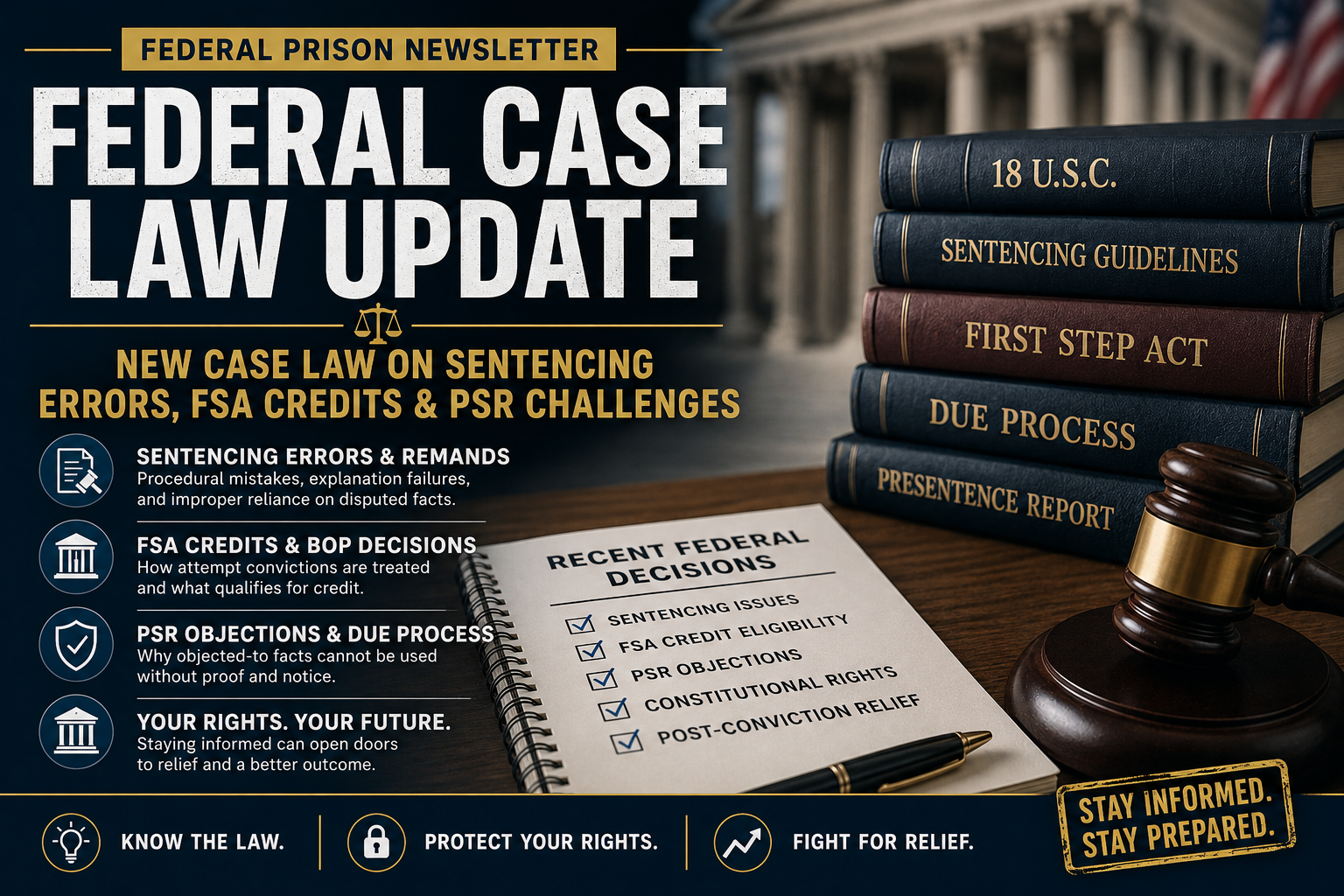
This week’s newsletter covers several favorable federal court decisions and developments affecting sentencing, convictions, and post-conviction relief. As always, the goal is to keep readers informed about important legal rulings that may impact ongoing cases, appeals, and future challenges in federal court.
United States v. McKenzie, 2026 U.S. App. LEXIS 17136 (1st Cir. June 12, 2026)
BOP Cannot Treat an Attempt Conviction as the Excluded Substantive Offense
The First Circuit clarified that the BOP was wrongly treating McKenzie’s attempt conviction as if it were a conviction for the completed offense when determining First Step Act credit eligibility. McKenzie was convicted under 18 U.S.C. sec. 1594, the attempt statute, even though the judgment also listed 18 U.S.C. sec. 1591 to identify the offense he attempted to commit. The court explained that referencing the underlying substantive offense does not transform an attempt conviction into a conviction for that substantive offense. That matters because the First Step Act excludes some substantive offenses but does not exclude every attempt or conspiracy tied to those offenses. If the BOP reads the object-offense citation on the judgment as the actual conviction statute, it can wrongly deny FSA credits. This same issue may apply in other attempt and conspiracy cases where the judgment lists the substantive offense, but the actual conviction is under a separate attempt or conspiracy statute.
United States v. Morilla, 2026 U.S. App. LEXIS 17001 (11th Cir. June 11, 2026)
Judge’s “Same Sentence Anyway” Statement Did Not Cure Guidelines Error
The Eleventh Circuit vacated Morilla’s sentence because the district court’s alternative-sentence statement was not enough to make its Guidelines error harmless. A judge cannot insulate a sentence from appellate review simply by saying the same sentence would apply even if the Guidelines calculation was wrong. That statement must come after the court has completed the real sentencing process, including hearing the parties’ 18 U.S.C. sec. 3553(a) arguments and giving the defendant a meaningful chance to allocute. Here, the court made the “same sentence anyway” statement too early, before those required steps occurred. The problem is simple: if the judge has not yet heard mitigation, argument, and allocution, the judge cannot reliably say the same sentence would still be imposed after considering them. Because the premature statement did not show the Guidelines error had no effect on the sentence, the sentence was vacated and remanded.
United States v. Washington, 2026 U.S. App. LEXIS 16597 (7th Cir. June 9, 2026)
Judge Must Explain How the 3553(a) Factors Apply
The Seventh Circuit vacated Washington’s sentence because the district court merely listed the 18 U.S.C. sec. 3553(a) factors without explaining how those factors applied to him. A sentencing judge does not have to give a long explanation, but the record must show an individualized assessment based on the defendant’s arguments and circumstances. It is not enough to say the sentence reflects the seriousness of the offense, promotes respect for the law, provides just punishment, protects the public, and avoids unwarranted disparities. Those are labels, not reasoning. When a defendant raises real mitigation arguments, the court must show why those arguments did or did not affect the length of the sentence. Because the judge did not explain how the sec. 3553(a) factors supported the 70-month sentence, the sentence was vacated and remanded.
United States v. Watson, 2026 U.S. App. LEXIS 16463 (4th Cir. June 8, 2026)
Alternative Sentencing Options Still Must Stay Within the Statutory Limit
The Fourth Circuit vacated Watson’s sentence because the district court used home detention to impose more punishment than the statute allowed. Home detention can be ordered only as an alternative to incarceration, not as extra punishment stacked on top of the maximum prison term. That means a court must treat home detention on a one-for-one basis: one month of home detention can replace one month of prison the court could have imposed, but it cannot exceed the amount of prison time still legally available. Because Watson’s prison sentence left only 7 months below the statutory revocation maximum, the court could not add nearly 21 months of home detention. The basic rule is simple: even when a judge uses alternatives to prison, the total sentence still has to fit within the statutory limits Congress set.
United States v. Maldonado-Maldonado, 2026 U.S. App. LEXIS 16475 (1st Cir. June 8, 2026)
Judge Cannot Rely on Undisclosed Facts Outside the Record
The First Circuit vacated Maldonado’s sentence because the district court relied on facts outside the record that were never disclosed to the defense. A defendant has the right to be sentenced based on accurate and reliable information, and that includes the right to know and challenge the facts the judge is considering. Even if the information comes from probation, new and significant sentencing facts cannot be used unless the defense has notice and a fair chance to respond. The court cannot rely on undisclosed information to evaluate rehabilitation, recidivism, respect for the law, or any other sentencing factor. Because the judge considered recent disciplinary violations that were not in the PSR and were not disclosed before sentencing, the sentence was vacated and remanded before a different judge.
United States v. Hutchinson, 2026 U.S. App. LEXIS 16166 (8th Cir. June 4, 2026)
Judge Cannot Use the PSR Itself to Overrule a PSR Objection
The Eighth Circuit vacated Hutchinson’s sentence because the district court relied on disputed PSR allegations without requiring the government to prove them. Once a defendant objects to factual allegations in the PSR, those allegations are no longer facts the court can simply accept. The PSR is not evidence, and it cannot be used as the proof needed to overrule the objection. At that point, the court has only a few lawful options: require the government to present evidence proving the disputed facts, sustain the objection, or state that the disputed facts will not affect the sentence and will not be considered. What the court cannot do is say the allegations stay in the PSR because they appear in discovery, sound plausible, or are consistent with the type of offense. Because the district court treated unproven, objected-to allegations as usable sentencing facts, the sentence was vacated and remanded for resentencing without consideration of those allegations.
NEWS: It’s official: The Sentencing Commission said it is not considering making any of the upcoming amendments retroactive. The statement was found in a release in the Federal Register on Friday: “Beyond the consideration of possible policy priorities this year, the Commission has chosen to not solicit public comment or hold a hearing on retroactivity. When the Commission submits amendments to Congress, it may decide to publish an issue for comment and hold a hearing on whether to make some or all of those amendments retroactive. See USSC Rules of Practice and Procedure 4.1. The Commission is not taking these steps for any of the amendments submitted to Congress on April 30, 2026.”
Download the Free Habeas Guide
Download the free guide, Insider’s Guide to Using Habeas Corpus to Get Out of Prison, for a practical overview of how habeas corpus works and why many post-conviction filings fail.


Dale Chappell prepares people in sensitive, high-profile, and high-stakes federal cases for prison. He works with clients, families, and attorneys during pretrial, throughout incarceration, and during the transition to halfway house placement, home confinement, and supervised release.
Dale brings more than 17 years of experience, firsthand knowledge of the federal prison system, and experience testifying at high-profile public hearings on prison and criminal justice issues. He helps clients protect their safety and privacy, avoid decisions that can follow them throughout their sentences, and prepare for the strongest possible outcome at every stage.
Dale has written nearly 600 published articles on federal prison, post-conviction, and criminal justice issues.
Have questions?
Contact Dale directly at dale@facingfederalprison.com.
Leave a Reply