
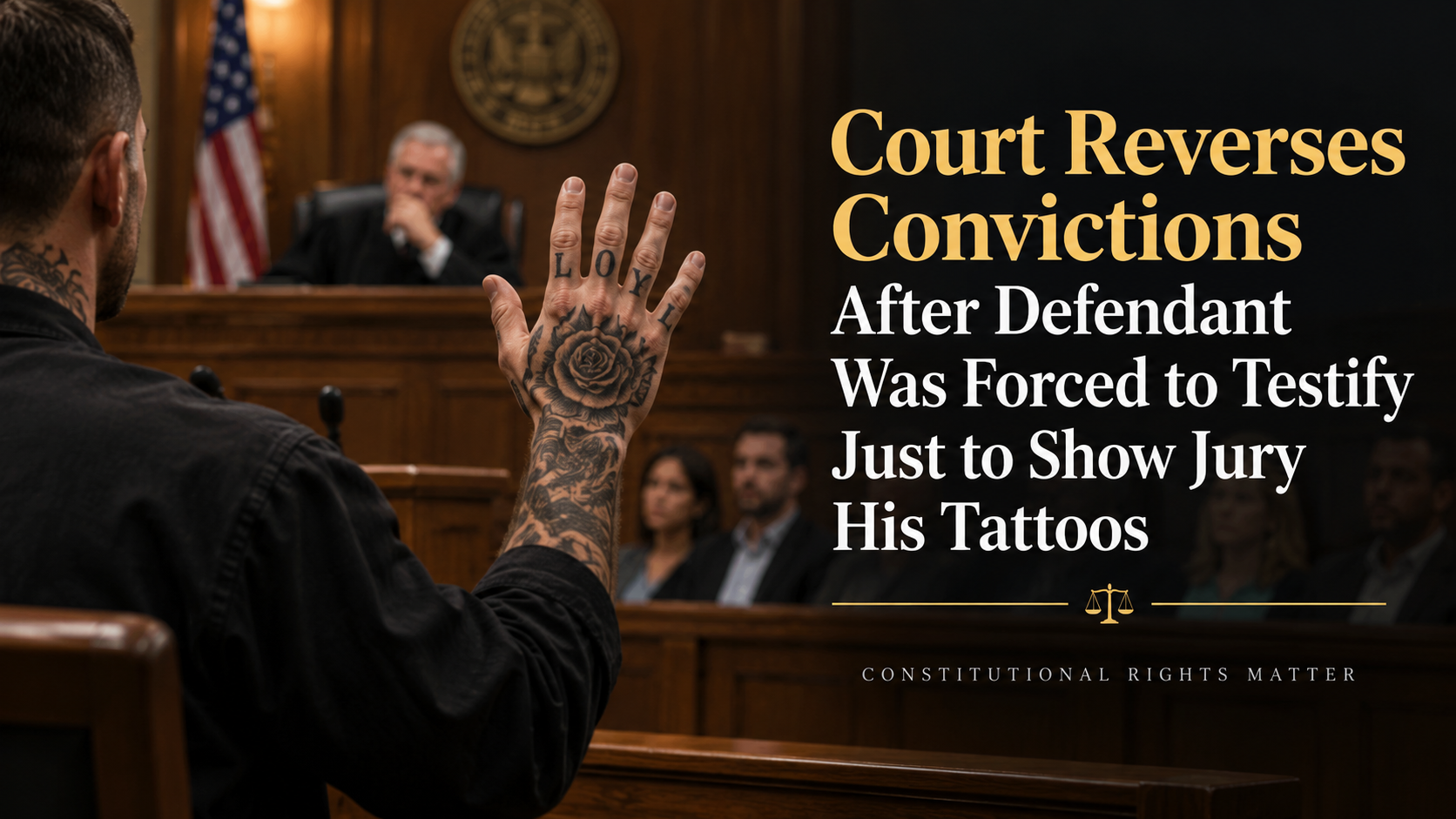
The Ninth Circuit reversed Eduardo Valencia’s robbery and firearm convictions because the trial judge forced him to take the witness stand simply to show the jury the tattoos on his hands. The court held that displaying a physical characteristic such as a tattoo is not testimony. Because Valencia was not “testifying” merely by showing the jury his hands, the judge could not require him to take the stand and submit to cross-examination as the price for presenting that evidence. By forcing him to choose between showing potentially exculpatory physical evidence and preserving his Fifth Amendment right to remain silent, the court violated his constitutional rights.
In United States v. Valencia, 2026 U.S. App. LEXIS 27285 (9th Cir. Sept. 3, 2026), the Ninth Circuit held that the district court violated Valencia’s Fifth Amendment privilege against self-incrimination by requiring him to testify before he could display his tattooed hands to the jury. The error became even more serious because the government later used testimony Valencia never should have been required to give to attack his credibility. The court concluded that the constitutional violation was not harmless and ordered a new trial.
The Tattoos Were Part of the Defense
Valencia was charged with Hobbs Act robbery and brandishing a firearm during the November 2020 armed robbery of La Milpa Market in Yakima, Washington. Two masked men entered the store, threatened and assaulted the manager, and escaped with approximately $16,000. Investigators recovered a glove dropped by one of the robbers, and DNA on that glove matched Valencia. An envelope left at the scene was addressed to Valencia’s parents’ home and had been sent by his child’s school district. Police also tied a black Chrysler 300 to the robbery, and Valencia was later arrested while driving a black Chrysler 300.
But identification was still contested. Valencia had tattoos covering the backs of his hands, and the surveillance footage, although blurry, did not appear to show tattoos on the exposed left hand of the robber who lost the glove. That gave the defense a straightforward identification argument: if Valencia’s hand was heavily tattooed at the time of the robbery but the robber’s hand was not, Valencia might not have been the person shown in the video. The defense therefore wanted Valencia simply to show his hands to the jury without taking the stand.
The Trial Judge Treated Showing His Hands as Testimony
Valencia’s attorney argued that displaying his hands was physical evidence, not testimonial evidence, and therefore should not subject Valencia to cross-examination. The district court disagreed and ruled that displaying the tattoos would constitute testimony, meaning Valencia would have to take the witness stand if he wanted the jury to see them.
That ruling was especially problematic because the government itself brought controlling Ninth Circuit precedent to the judge’s attention. In United States v. Bay, 762 F.2d 1314 (9th Cir. 1984), the Ninth Circuit had already addressed essentially the same issue. Bay involved a robbery defendant who wanted to display distinctive tattoos on his hands after a witness describing the robber had said nothing about tattoos. The Ninth Circuit held that displaying an identifying physical characteristic was not testimonial and that the defendant could not be forced to take the stand merely to show the jury his tattoos.
The prosecutor in Valencia’s case specifically told the district court that Bay meant Valencia could “just show them” and that the government could not cross-examine him merely because he displayed his hands. The district judge nevertheless declined to follow Bay, stating that he was “willing to roll the dice” because he believed the government should be permitted to question Valencia about the tattoos. That decision became the central issue on appeal.
Why Showing a Tattoo Is Not Fifth Amendment Testimony
The Fifth Amendment protects a criminal defendant from being compelled to testify against himself. But that protection applies to testimonial evidence, not every form of physical evidence. Courts have long distinguished between forcing someone to communicate information from his mind and requiring someone to display an identifying physical characteristic.
That distinction was the key to Valencia. Showing the jury what a person’s hand looks like does not itself communicate a statement. It is simply the display of a physical characteristic. Bay had already made the point directly: if the government can require a defendant to display identifying physical characteristics without violating the Fifth Amendment, then a defendant must also be able to display those same characteristics for his own defense without being forced to testify.
The constitutional problem was therefore not that Valencia’s tattoos were shown to the jury. The problem was the price the district court placed on showing them. Valencia was given an unconstitutional choice: either abandon potentially exculpatory physical evidence or surrender his Fifth Amendment right not to testify. The Ninth Circuit held that the Constitution did not permit the court to force that choice.
Sitting at Counsel Table Was Not Enough
The government tried to distinguish Bay by arguing that jurors could already see Valencia’s hands while he sat at counsel table. The Ninth Circuit rejected that argument because merely being visible in the courtroom is not the same as deliberately presenting a physical characteristic as evidence.
The court explained that “courtroom geography” should not determine whether a defendant must surrender his Fifth Amendment rights to present potentially exculpatory physical evidence. A defendant seated farther from the jury should not have fewer rights than one seated closer to it. The question was whether Valencia could affirmatively display his hands to support his defense without becoming a witness, and under Bay the answer was clearly yes.
The Forced Testimony Made the Error Worse
Because Valencia wanted the jury to examine his tattoos, he took the stand and testified that the tattoos on his left hand had been there for close to nine years. Once he testified, the government briefly cross-examined him about the tattoos. Afterward, the government discovered a Facebook photograph posted in June 2020 that appeared to show Valencia without some of the distinctive tattoos on his fingers. The robbery occurred several months later.
The district court allowed the government to reopen its case and introduce the photograph. During closing argument, the prosecutor then emphasized the apparent inconsistency between the Facebook photograph and Valencia’s testimony that the tattoos had been there for approximately nine years. In other words, the unconstitutional ruling did not simply force Valencia onto the witness stand. It created testimony the government later used to argue that Valencia was not credible.
That is why the distinction between physical evidence and testimony mattered so much. Valencia never wanted to testify about when he received his tattoos. He wanted only to let the jury look at his hands. Had the district court followed Bay, there would have been no compelled testimony about the age of the tattoos and no resulting credibility attack based on that testimony.
The Error Was Not Harmless
Because the error involved Valencia’s Fifth Amendment rights, the government had to prove beyond a reasonable doubt that the violation did not affect the verdict. The Ninth Circuit held that it could not meet that demanding standard.
The government pointed to the DNA evidence, the envelope found at the scene, the Chrysler 300, and the relatively short jury deliberations. But the Ninth Circuit focused on what actually happened at trial. The government considered Valencia’s tattoo testimony important enough to reopen its case after finding the Facebook photograph, and it then used the apparent inconsistency in closing argument to challenge Valencia’s credibility.
The jury’s own conduct was also important. During deliberations, the jurors specifically asked to see current pictures of Valencia’s hands, and the district court instead allowed Valencia to display his hands to them again in person. The Ninth Circuit found it difficult to accept the government’s argument that the tattoos played no meaningful role in the verdict when the jury itself specifically requested another look at them.
The court also rejected the argument that short deliberations proved the error harmless. A quick verdict does not reveal why jurors reached their decision. The other evidence may have convinced them, but the Ninth Circuit said it was also possible that the tattoo testimony and the government’s resulting credibility attack carried the day. Because the government could not establish harmlessness beyond a reasonable doubt, the convictions had to be reversed.
A Trial Judge Cannot Ignore Controlling Circuit Law
Valencia is also notable because of how directly the Ninth Circuit addressed the district judge’s refusal to follow Bay. The appellate court emphasized that a district judge cannot simply disagree with controlling published precedent from the court of appeals. Once the Ninth Circuit had decided Bay, district courts within the circuit were required to follow it unless and until it was overruled by a court with authority to do so.
Here, the prosecutor correctly identified Bay and even explained its effect to the trial court. The judge nevertheless chose to “roll the dice.” The Ninth Circuit responded in equally direct terms, calling the resulting Fifth Amendment violation “error, snake eyes, by any measure.”
What Valencia Means for Criminal Defendants
Valencia reinforces an important Fifth Amendment principle: presenting physical evidence is not the same thing as giving testimony. A defendant does not automatically become a witness merely because the defense asks the jury to observe an identifying physical characteristic such as a tattoo. Courts cannot condition the presentation of that evidence on the defendant surrendering the constitutional right to remain silent.
The case is especially useful where identification is disputed and a defendant possesses a physical characteristic that appears inconsistent with eyewitness testimony, photographs, surveillance footage, or other evidence describing the perpetrator. More broadly, Valencia shows how a seemingly narrow evidentiary ruling can fundamentally alter a trial. The district court’s mistake forced Valencia to testify, generated statements the government later contradicted with additional evidence, and gave the prosecutor a new credibility argument that otherwise would not have existed.
Because Valencia should have been allowed to display his hands without taking the witness stand, the Ninth Circuit reversed both convictions and remanded the case for a new trial.

Dale Chappell prepares people in sensitive, high-profile, and high-stakes federal cases for prison. He works with clients, families, and attorneys during pretrial, throughout incarceration, and during the transition to halfway house placement, home confinement, and supervised release.
Dale brings more than 17 years of experience, firsthand knowledge of the federal prison system, and experience testifying at high-profile public hearings on prison and criminal justice issues. He helps clients protect their safety and privacy, avoid decisions that can follow them throughout their sentences, and prepare for the strongest possible outcome at every stage.
Dale has written nearly 600 published articles on federal prison, post-conviction, and criminal justice issues.
Have questions?
Email Dale directly at dale@dale-chappell.com.
Leave a Reply