
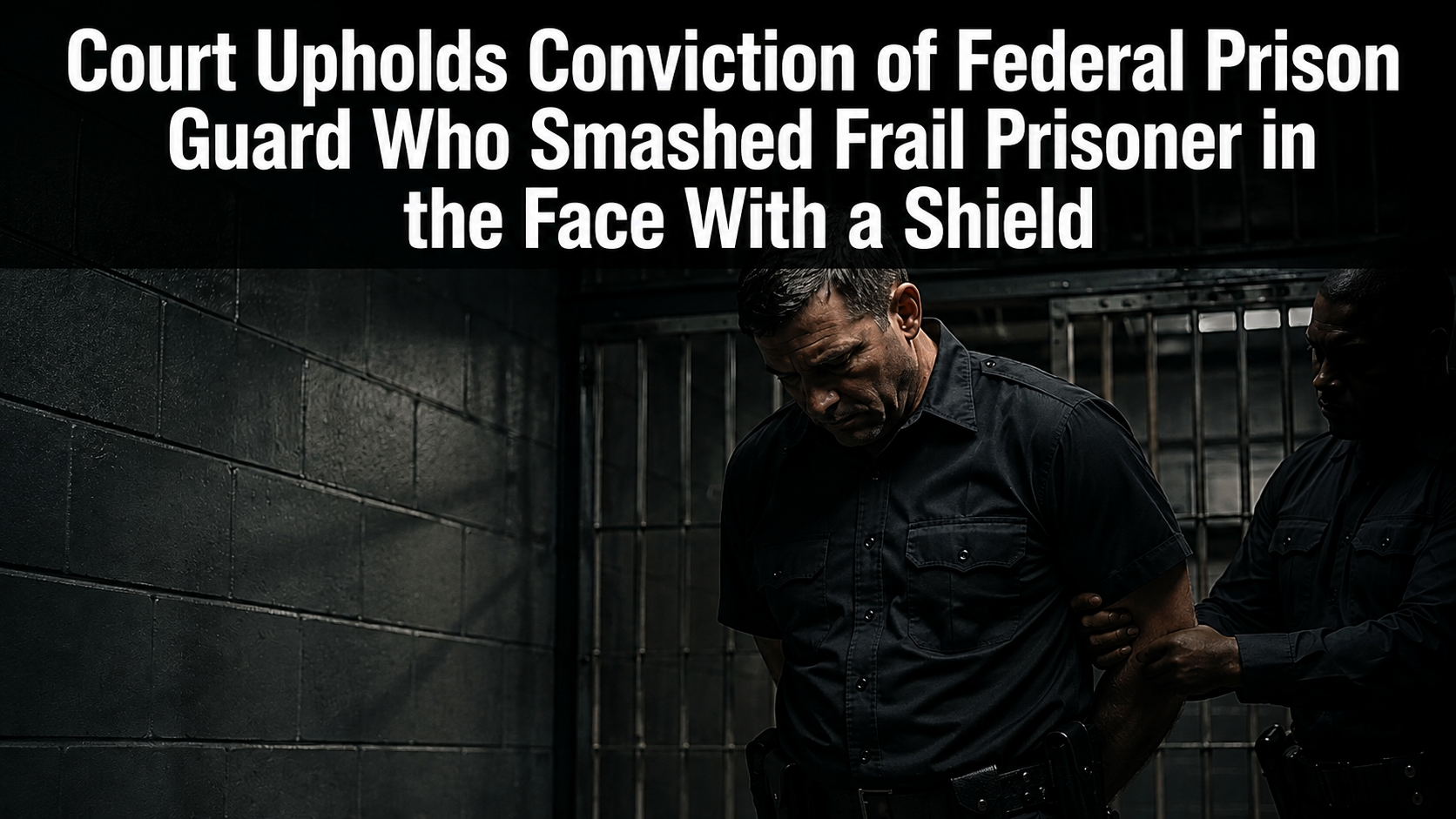
A federal appeals court has upheld the criminal conviction of a Bureau of Prisons correctional officer who used a protective shield as a weapon against a severely mentally ill, physically frail prisoner who was already handcuffed behind his back. The prisoner weighed only about 150 to 160 pounds after losing roughly 70 pounds, and was described in the record as having “no muscular definition” and being “emaciated.”
In United States v. Bourget, 2026 U.S. App. LEXIS 25407 (1st Cir. Aug. 21, 2026), the First Circuit affirmed Former Federal Prison Guard Seth Bourget’s conviction under 18 U.S.C. § 242 for willfully violating a prisoner’s constitutional rights during a forced cell move at Federal Medical Center Devens. A jury found that Bourget drove the top of a protective shield upward into the prisoner’s chin and face, knocking him backward and causing serious injuries, including a head wound that required 12 staples.
KT Was Severely Mentally Ill and Physically Deteriorating
What makes this case unusual is not simply that a prisoner was hurt during a use-of-force incident. Those allegations happen constantly. What is unusual is that a correctional officer was actually criminally prosecuted, convicted by a jury, and then had that conviction upheld on appeal. Prison officials are rarely held criminally accountable for violating prisoners’ rights, and that is what makes this decision worth paying attention to.
The prisoner was identified in the opinion only as KT. He was housed at FMC Devens, where he was receiving mental-health treatment. The court described him as suffering from delusions and auditory hallucinations and noted diagnoses including an unspecified psychotic disorder, a neurodevelopmental disorder, and autism spectrum disorder.
A staff psychologist described KT as “the most mentally ill person” he had ever seen and compared KT’s mental capacity to the “range between a child and a teenager.” His physical condition was also poor. The court said KT had lost approximately 70 pounds over the prior year and a half, weighed around “160, 150-something” pounds, and had little muscle definition. Later in the opinion, the court noted testimony that he had “no muscular definition” and was “emaciated.”
Those details mattered because they went directly to the question of how much of a threat KT realistically posed when a five-man use-of-force team entered his cell.
What Happened Inside FMC Devens
On June 18, 2019, KT had an altercation with a nurse. Officers responded, restrained him, handcuffed his hands behind his back, and moved him into a holding cell in the N-1 mental-health unit, the most secure unit in the mental health ward.
KT remained agitated and was speaking incoherently. He also tried to spit at officers. At one point, spit mixed with blood struck Bourget in the face and forearm. Bourget became upset and concerned that he might contract a disease.
Officers sprayed KT with OC spray, but he continued trying to spit. Eventually, a use-of-force team was assembled to enter the cell, decontaminate him, and move him. Bourget was designated the “number one man,” meaning he would be the first officer through the door and would be responsible for securing KT’s head and torso. One officer testified that Bourget volunteered for that position.
Before the team entered, Bourget told KT, “f*** you.” Then the cell door was opened and the team rushed in at “full speed.”
Bourget entered first carrying a large protective shield. According to the court, he used an upward motion with the shield and struck KT in the chin and face. KT fell backward and hit his head on the wall or floor. Blood was smeared on the wall and pooled on the ground.
KT later went to the hospital. He had a 2.5-centimeter laceration on his face and a 3-centimeter laceration on the back of his scalp. Doctors used 12 staples to close the head wound. Medical staff later documented substantial bruising and swelling to his face. One lieutenant testified that the injuries “weren’t normal” compared with what he had seen after other calculated uses of force.
Why the Conviction Was Upheld
Bourget was convicted under 18 U.S.C. § 242, which makes it a federal crime for someone acting under color of law to willfully deprive another person of a constitutional or federal right.
The government had to prove more than a bad use-of-force decision. It had to prove that Bourget acted willfully and that the force was applied “maliciously and sadistically” rather than in a good-faith effort to maintain or restore discipline.
The First Circuit concluded that the evidence was enough for a jury to make that finding. The court looked at several factors, including the level of threat KT posed, whether force was needed, whether the amount of force was proportional to that need, the extent of KT’s injuries, and whether officers tried to limit the severity of the force.
On the first issue, the court found that a jury could reasonably conclude that KT posed a low threat when the officers entered the cell. He was standing with his hands cuffed behind his back, had already been sprayed with OC spray, was physically deteriorated, and was surrounded by five officers wearing protective equipment. The court also noted testimony that KT was not making threatening statements or aggressive movements at the moment the team entered.
That did not mean officers had no reason to enter the cell. The court acknowledged that some force was necessary because KT needed to be decontaminated and moved.
But that is very different from saying any amount of force was justified.
The Shield Was Supposed to Be Defensive
One of the strongest points for the government was the testimony about how shields were supposed to be used.
Captain Michael Bollinger testified that BOP staff were trained to use the minimum amount of force necessary to control a situation. He also testified that a shield was a defensive piece of equipment and was not supposed to be used as a weapon.
Bollinger said officers were not trained to move a shield upward toward the head or neck because doing so could cause serious injury or death.
The jury also had the video. The First Circuit said jurors could watch Bourget “spear” KT with the shield and reasonably conclude that the amount of force used was far greater than what was needed under the circumstances.
This is an important distinction because Bourget’s defense tried to focus heavily on the fact that officers are trained to enter cells quickly during forced cell moves. The First Circuit did not hold that entering quickly was the crime. The problem was how the shield was used once Bourget entered.
The Jury Had Evidence of Malice
Bourget also argued that there was not enough evidence to prove he intended to violate KT’s rights. The court disagreed.
Jurors heard that Bourget had just been spit on and was upset. They heard that he expressed an interest in spraying KT again with OC spray. They heard that he volunteered to be the number one officer on the team. And they heard that he told KT “f*** you” before the forced entry.
Most importantly, the court concluded that the jury could reasonably find that, with five officers in body armor rushing a physically frail man whose hands were cuffed behind his back, “there was no reason to use a shield as a spear other than to harm KT.”
That sentence gets directly to why the conviction survived. The court was not saying correctional officers cannot use force. It was saying that a jury could distinguish between legitimate force used to control a prisoner and force used for the purpose of hurting him.
Even Other Officers Thought the Video Looked Bad
The jury also heard testimony about how other correctional officers reacted after watching the recording.
Captain Benjamin Quinn testified that another officer who had already seen the video said “it was bad.” Quinn then watched it himself and agreed, specifically pointing to the way Bourget used the shield.
That testimony mattered because these were not outsiders unfamiliar with correctional work. They were officers who understood forced cell moves and BOP use-of-force procedures. They apparently recognized immediately that the shield use was a problem.
Bourget Blamed the Training
Bourget’s strongest defense was that BOP training contributed to what happened.
Several officers testified that they were trained to enter cells at “100 percent” or full speed during forced cell moves. Bourget also argued that he had never been adequately trained on how to use a shield during such an entry.
He wanted the jury in his second trial to see another video involving a prisoner named Sion. Bourget had previously been the lead officer in a forced cell move involving Sion, and that video had later been shown during BOP training.
The defense argued that the Sion video would have helped show what Bourget believed a proper forced cell entry looked like.
The district court excluded the video from the second trial, and the First Circuit upheld that ruling. The majority emphasized that the Sion incident was different in important ways. Sion was not handcuffed. Officers had escalated through several other types of force before entering. And no shield was used during the cell entry.
The court also said the evidence showed that the Sion video was used in training to demonstrate how officers transitioned between different types of force, not to teach officers how to perform a forced cell move.
The Concurrence Made the Real Issue Even Clearer
Judge William Kayatta wrote separately and made the point even more directly.
The government was not arguing that Bourget committed a crime because he entered the cell too quickly. In fact, the prosecutor acknowledged that officers sometimes need to go in fast.
The real issue was that Bourget allegedly used the shield “as a weapon” and drove it upward into KT’s face and chin.
Because no shield was used in the Sion video, Judge Kayatta concluded that the video would either have hurt Bourget’s defense or confused the jury about what the case was really about.
The Dissent Went in a Very Different Direction
Judge Sandra Lynch dissented, arguing that the conviction should have been overturned.
Her dissent focused on the extraordinary deference courts traditionally give prison officials.
Judge Lynch cited Supreme Court language warning against creating “negative systemic consequences for prison officials” and interfering with the “inordinately difficult undertaking” of running a prison. She also cited the familiar rule that prison administrators are entitled to “wide-ranging deference” in decisions involving security and discipline.
That is where the dissent becomes troubling. There is obviously a place for deference. Courts cannot micromanage prisons. Correctional officers sometimes have to use force. And prison officials often have to make difficult decisions quickly.
But that cannot become a blank check. This was not a dispute over whether a prison should conduct a search or move someone to another housing unit. This was a criminal prosecution in which a jury watched the video and concluded beyond a reasonable doubt that a correctional officer willfully violated a prisoner’s constitutional rights.
At some point, “deference to prison officials” has to stop.
Prison Officials Already Get Away With Too Much
Anyone who has spent serious time dealing with prison litigation knows how difficult it is to hold correctional employees accountable.
Prisoners have to exhaust administrative remedies. Evidence is often controlled by the same institution they are accusing of misconduct. Staff members can back each other up. Courts routinely defer to institutional-security claims. Civil lawsuits face major procedural barriers. And criminal prosecutions of officers are exceptionally rare.
That is why Bourget is important. This case does not show that the system aggressively prosecutes officers who violate prisoners’ rights. It shows the opposite. Cases like this stand out precisely because criminal accountability is so uncommon.
Prison employees possess enormous power over people who cannot simply walk away. They control housing, movement, discipline, communication, property, medical access, and nearly every other aspect of daily life.
That power has to have limits.
The Sentence Was Only a Year and a Day
Despite the seriousness of the conduct, Bourget was sentenced to only one year and one day in federal prison, followed by two years of supervised release.
People familiar with federal sentencing immediately understand why one year and one day matters. Federal good conduct time applies only to prisoners serving terms greater than one year. A sentence of one year or less does not qualify.
So even after a federal jury convicted a correctional officer of willfully violating a prisoner’s constitutional rights and causing serious bodily injury, the sentence was structured so that he could qualify for good conduct time and serve less than the full sentence imposed.

Dale Chappell prepares people in sensitive, high-profile, and high-stakes federal cases for prison. He works with clients, families, and attorneys during pretrial, throughout incarceration, and during the transition to halfway house placement, home confinement, and supervised release.
Dale brings more than 17 years of experience, firsthand knowledge of the federal prison system, and experience testifying at high-profile public hearings on prison and criminal justice issues. He helps clients protect their safety and privacy, avoid decisions that can follow them throughout their sentences, and prepare for the strongest possible outcome at every stage.
Dale has written nearly 600 published articles on federal prison, post-conviction, and criminal justice issues.
Have questions?
Email Dale directly at dale@dale-chappell.com.
Leave a Reply