
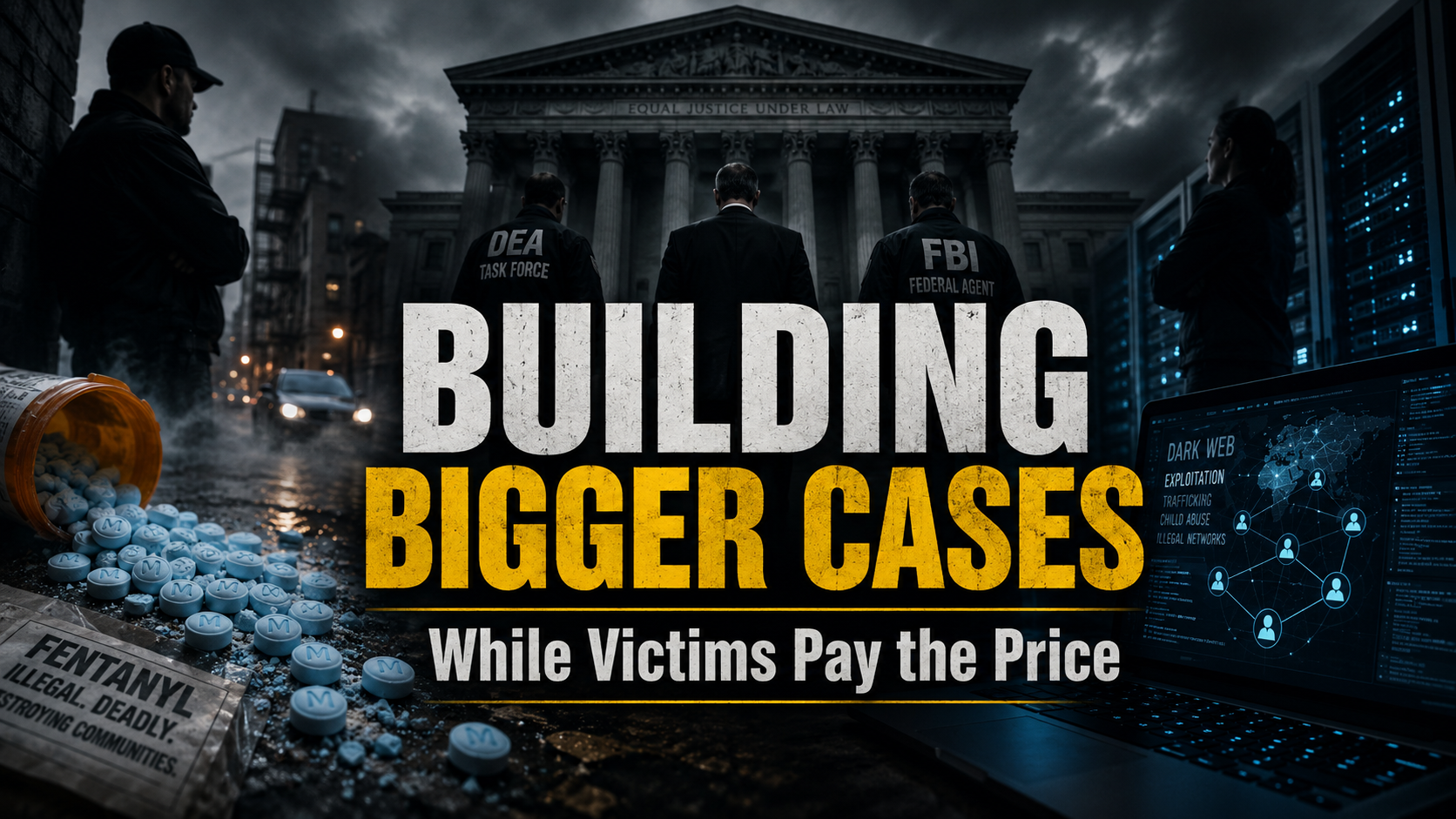
The Government Isn’t Just Prosecuting Bigger Cases. It’s Building Them While Victims Pay the Price.
The federal government loves to say it only gets involved in “big cases.”
That sounds reasonable on paper. Nobody expects federal agents and federal prosecutors to take every street-level drug case, every low-level internet case, or every local crime that state authorities can handle. The federal system has limited resources, and the public is told those resources are reserved for the major players: the traffickers, the organizations, the networks, the people causing the most harm.
That is the story the government tells. But the reality is a lot uglier.
In too many cases, the government does not simply pursue big cases. It creates big cases. It watches. It waits. It lets the conduct continue. It allows more drugs to hit the street, more contraband to circulate, more victims to be harmed or killed, and more evidence to pile up until the case becomes large enough for the government to stand in front of cameras and claim it just took down a major operation.
That is not public safety. That is case building. And there is a difference.
The DEA Fentanyl Story Exposes the Game
According to a recent AP report, DEA agents in New Mexico allegedly monitored fentanyl shipments but did not seize them because federal prosecutors wanted to build bigger criminal cases. We are not talking about some low-risk controlled substance. We are talking about fentanyl, the same drug the government warns people about with slogans like “One Pill Can Kill.”
And fentanyl does kill. The government knows it. The DEA knows it. Prosecutors know it. Courts know it. But according to the AP report, agents allegedly watched shipments of tens of thousands of pills get passed onto the streets.
The story describes DEA agents having detailed intelligence, including the ability to estimate pill counts from intercepted communications and surveillance. In one example, agents allegedly watched a 74,000-pill delivery and did nothing to stop it. A whistleblower reportedly claimed that in another investigation, at least 1.8 million fentanyl pills were allowed to move while the case continued.
The government’s position is basically this: fentanyl is so dangerous that one pill can kill, but not so dangerous that we need to stop shipments when stopping them might interfere with building a bigger case.
The government tells the public it is protecting them. But when the public could actually be protected by stopping the harm immediately, the government often chooses the bigger case instead.
“We’re Going After the Bigger Fish” Is Not a Free Pass
The former U.S. Attorney quoted in the story defended the approach by saying the “bigger fish” are worth catching because that saves more lives.
That sounds good. But here is the problem: the government never has to prove the lives it supposedly saved by waiting. It only points to the size of the final bust.
Look at how this works. If agents seize the fentanyl today, the government gets one case. Maybe it gets a courier. Maybe it gets a mid-level distributor. Maybe it gets a smaller indictment.
If agents wait six months, more pills move. More people distribute. More people use. More people overdose. More people die. More evidence gets collected. Then the government announces a massive takedown and claims victory.
But what about the damage that happened during those six months? What about the pills that were not seized? What about the overdoses that could have been prevented? What about the families who buried someone while the government was “preserving the investigation”?
That never makes the press release.
The press release only talks about the final seizure, the number of defendants, the amount of drugs, and the heroic language about dismantling a dangerous organization.
But if the government allowed that organization to keep operating after it had enough information to intervene, then the public deserves to know that too.
This Is Not Just a Drug Case Problem
This same mindset shows up in child exploitation investigations. Years ago, in the Playpen operation, the FBI took control of a dark web site used to distribute child sexual abuse material (CSAM) and kept it running for months so it could ensnare more users.
The government’s argument was simple: if we shut the site down immediately, we only stop the site. If we keep it running, we catch more people. Again, that sounds reasonable until you ask the question the government does not want to answer:
What happens to the victims while the government waits?
CSAM is not just “evidence.” Every time that material is traded, accessed, downloaded, or viewed, the harm continues. The victimization continues. The government says this all the time when it wants long sentences. Prosecutors argue that each viewing revictimizes the person depicted.
Fine. Then the same logic should apply when the government is the one keeping the pipeline open. The government cannot have it both ways. It cannot tell sentencing judges that every click causes ongoing harm, then tell courts that it was acceptable for the FBI to keep a CSAM site running because the government wanted a bigger case.
If victim harm matters at sentencing, it should matter during the investigation.
Courts Keep Giving the Government a Pass
This is where the problem gets worse. Courts routinely give enormous deference to the government’s choice of investigative methods. Even when judges express concern about the government’s conduct, they often refuse to draw a hard line.
That creates a dangerous message: As long as the government says it was trying to make a bigger case, almost anything can be justified. Then, after the fact, the government points to the number of arrests and says, “See? It worked.”
But that is the wrong measuring stick. The question should not be only how many people were arrested. The question should be how much harm the government allowed after it had the power to stop it.
The courts rarely ask that question in a serious way. They talk about investigative necessity. They talk about law enforcement discretion. They talk about the difficulty of dismantling organizations. But they rarely force the government to account for the human cost of waiting.
That is how “public safety” becomes a slogan instead of a standard.
Arrest Numbers Do Not Equal Public Safety
The government loves numbers.
- Number of defendants charged.
- Number of pills seized.
- Number of devices searched.
- Number of images found.
- Number of years requested at sentencing.
Numbers make a case look important. Numbers make prosecutors look aggressive. Numbers make press releases look impressive.
But numbers can also hide the truth. If the government arrests 100 people after allowing criminal activity to continue for months, that does not automatically mean the operation protected the public. It may mean the government allowed the harm to grow until the numbers looked good enough to justify the federal case.
The federal system rewards big cases. Big cases bring headlines. Big cases bring promotions. Big cases bring press conferences. Big cases make agencies look effective.
Stopping harm early does not produce a big headline. Preventing a fentanyl shipment from reaching the street may save lives, but it may not create a massive indictment. Shutting down a CSAM server immediately may stop ongoing harm, but it may not identify as many users.
The Government Should Not Get Credit for Solving a Problem It Helped Grow
The government is rewarded for building big cases. Any time the government says it acted in the name of public safety, that claim should be tested.
Because “public safety” has become the government’s magic phrase. It is used to justify surveillance, harsh sentences, mandatory minimums, supervised release conditions, registry laws, detention, asset forfeiture, and almost every aggressive tactic prosecutors want courts to approve.
If law enforcement has the ability to stop dangerous conduct and chooses not to because it wants a bigger case, then it should not later get credit for stopping the bigger case.
That bigger case may exist only because the government allowed it to grow.
Imagine a firefighter watching a house burn because he wants to see whether the fire spreads to the next block so he can call it a major fire. Nobody would call that public safety.
But in criminal cases, the government does something similar and courts call it investigative strategy.
That needs to stop. There has to be a line. There has to be accountability. There has to be a serious judicial inquiry into whether the government could have stopped the harm earlier and chose not to.
And when the answer is yes, courts should not just shrug and say law enforcement gets deference.
Deference is not a blank check.
The Real Question Courts Should Ask
When defendants challenge these tactics, courts usually ask whether the government’s conduct was so outrageous that it violated due process. That is an extremely high bar, and prosecutors know it.
But courts should be asking more practical questions too: Did the government have the ability to stop the harm earlier? Did agents allow dangerous drugs, weapons, or illegal material to continue circulating? How many people were exposed to danger because agents waited? Was the delay truly necessary, or was it to simply make the case more impressive?
Those questions matter. Because without them, the government gets to write the story after the fact. And the story always sounds the same: We had to do it this way to catch the bigger fish.
Why This Matters for Defendants and Families
For people facing federal charges, this issue matters because the government’s narrative often controls the entire case.
The government will say the defendant was part of a major organization, a dangerous network, a serious threat, or a large-scale operation.
But what if the case only became “large-scale” because agents allowed it to continue? What if the government’s delay made the case worse, then prosecutors used that worsened case to demand a harsher sentence?
Defense attorneys need to dig into this. They need to request discovery. They need to challenge the timeline. They need to ask what the government knew, when it knew it, what it could have stopped, and why it did not stop it.
Because sometimes the most important part of the case is not what the defendant did. It is what the government allowed to happen after it already knew.

Dale Chappell prepares people in sensitive, high-profile, and high-stakes federal cases for prison. He works with clients, families, and attorneys during pretrial, throughout incarceration, and during the transition to halfway house placement, home confinement, and supervised release.
Dale brings more than 17 years of experience, firsthand knowledge of the federal prison system, and experience testifying at high-profile public hearings on prison and criminal justice issues. He helps clients protect their safety and privacy, avoid decisions that can follow them throughout their sentences, and prepare for the strongest possible outcome at every stage.
Dale has written nearly 600 published articles on federal prison, post-conviction, and criminal justice issues.
Have questions?
Contact Dale directly at dale@facingfederalprison.com.
Leave a Reply