
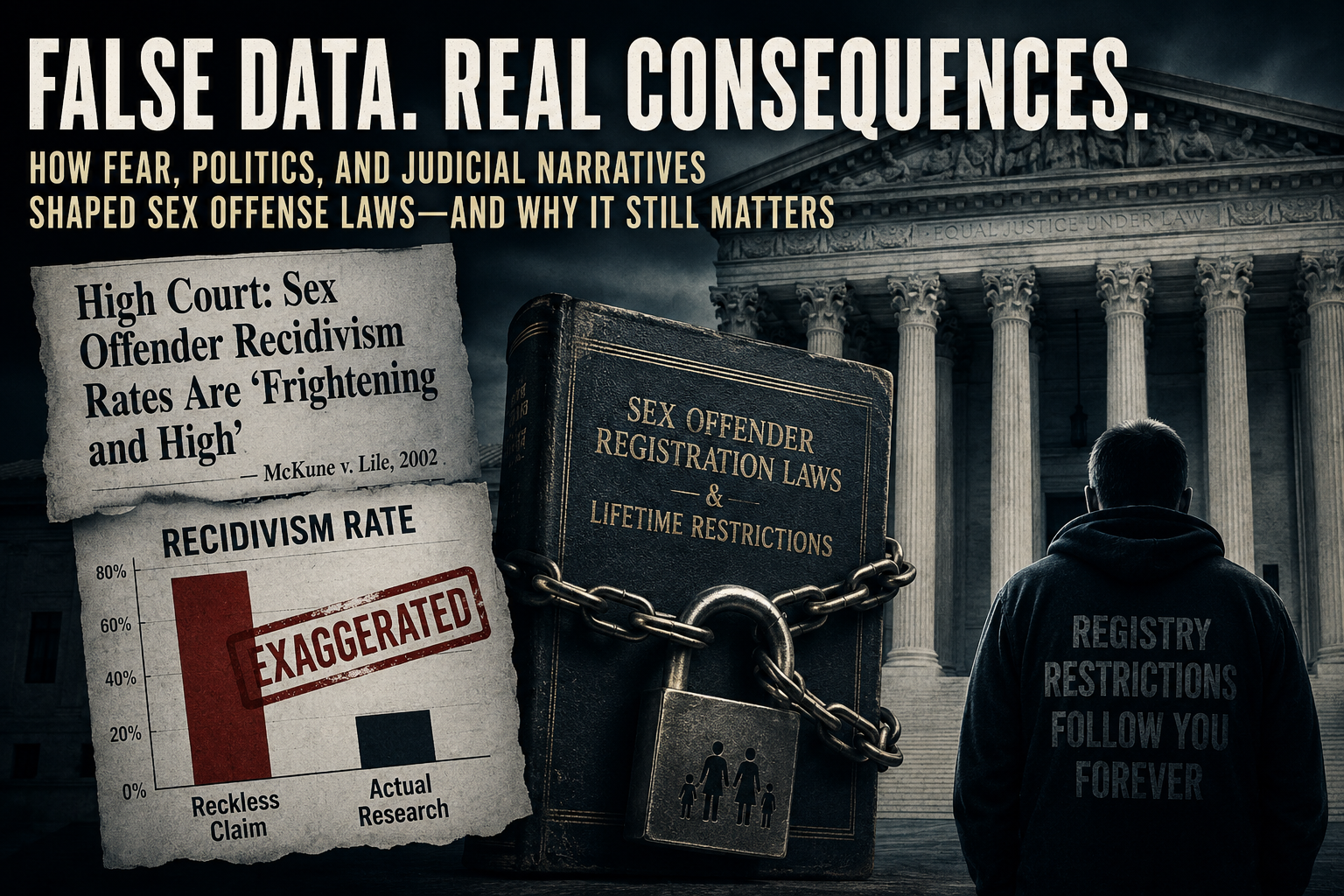
The “Frightening and High” Myth
The United States Supreme Court helped shape modern sex offender law by repeatedly describing sex offender recidivism as “frightening and high.” That phrase became the foundation for court decisions upholding harsh registry laws, lifetime supervision schemes, residency restrictions, and countless other collateral consequences imposed on registrants.
There was just one problem: the factual premise underlying that narrative was completely false.
What followed was not merely bad statistics but the transformation of weak and unsupported claims into legal doctrine. Once the Supreme Court adopted the narrative, courts and legislatures across the country repeated it for decades, even after later scholarship and research found evidence proved the narrative was false.
How Junk Science Became Constitutional Doctrine in Sex Offense Cases
The modern legal framework surrounding sex offender registration laws did not develop in a vacuum. Two Supreme Court decisions issued just one year apart helped create the constitutional foundation for nearly every modern registration and notification scheme in America.
In McKune v. Lile, 536 U.S. 24 (2002), the Court upheld a Kansas prison treatment program that pressured prisoners convicted of sex offenses to admit responsibility for uncharged sexual conduct or face significant institutional consequences. Writing for the court, Justice Kennedy described sex offenders as presenting a serious danger to society because their recidivism rates were “frightening and high.”
One year later, Kennedy repeated that same narrative in Smith v. Doe, 538 U.S. 84 (2003), the decision upholding Alaska’s sex offender registration law. The Court concluded that Alaska’s registry was a civil regulatory measure rather than punishment, allowing the state to impose registration requirements retroactively on people whose convictions predated the law by decades.
The problem is that the Supreme Court’s “frightening and high” claim was not based on rigorous empirical research or any evidence at all.
Later scholarship revealed that the claim traced back to a non-peer-reviewed article written by a therapist who was actively promoting sex offender treatment programs to prisons and correctional systems. The author admitted the article was more like a marketing piece than a serious scientific study, yet the Court repeated its conclusions as if they were settled fact.
The study described the author of that article this way:
“Nor does its author appear to have the scientific credentials that would qualify him to testify at trial as an expert on recidivism. He is a counselor, not a scholar of sex crimes or re-offense rates, and the cited article is not about recidivism statistics. It’s about a counseling program for sex offenders he then ran in an Oregon prison. His unsupported assertion about the recidivism rate for untreated sex offenders was offered to contrast with his equally unsupported assertion about the lower recidivism rate for those who complete his program.”
Courts routinely justified sex-offender restrictions by citing the same underlying assumption repeated in McKune and Smith, that individuals convicted of sex offenses posed an extremely high risk of committing future offenses. The phrase “frightening and high” quickly became embedded in American jurisprudence. As Ira Mark Ellman & Tara Ellman observed in their study, the phrase appeared in hundreds of cases after the Supreme Court adopted it.
The Supreme Court treated the claim of extraordinarily high sex offense recidivism as settled fact. It was not. The data supporting that narrative was flat out false. Yet once the Supreme Court adopted the narrative, lower courts and legislatures repeated it for decades as if it were empirically unquestionable.
The consequences of that mistake continue to shape American sex-offender law today.
The “Frightening and High” Claim Was Built on False Data
The phrase “frightening and high” did not emerge from a comprehensive and empirical study about sex offense recidivism. As later scholars demonstrated, the Supreme Court’s claim traced back to a non-scientific publication that lacked any proof.
The Ellmans explained that the “frightening and high” language ultimately originated from unsupported assertions that became repeated through citation chains until they acquired the appearance of authority. What began as a weak and generalized claim eventually hardened into accepted constitutional “fact” simply because courts continued quoting one another.
That process matters because courts often treat factual assertions contained in Supreme Court opinions as settled truths. Once the Supreme Court made the “frightening and high” claim, lower courts began citing it to justify harsher restrictions on registrants. Legislatures did the same.
But the empirical support for the claim never matched the confidence with which it was repeated.
Scholars, researchers, and even later courts increasingly recognized that the Supreme Court’s characterization of sex offense recidivism was deeply misleading. As law professor Catherine Carpenter observed, legislatures and courts continued relying on “entrenched myths” that exaggerated recidivism rates and overstated the public-safety benefits of registration schemes.
The Sixth Circuit similarly acknowledged that modern research undercut the assumptions driving many registration laws. In Does #1–5 v. Snyder, the court noted that studies failed to support the claim that registries meaningfully reduce recidivism and recognized that people convicted of sex offenses do not reoffend at the dramatically elevated rates often assumed in public discourse. Carpenter likewise cited research demonstrating that those convicted of sex offenses often recidivate at lower rates than other categories of offenders.
Yet by the time this research gained traction, the damage had already been done.
The Supreme Court had already enshrined in law the narrative. Registration systems had already expanded nationwide. Courts had already spent years treating registrants as more dangerous based on a factual premise that was, at best, profoundly overstated.
Courts Continued Repeating the Narrative Even After the Data Was Challenged
One of the most striking aspects of modern sex offense jurisprudence is that courts continued relying on the “frightening and high” narrative even after substantial empirical criticism emerged regarding the underlying data.
Rather than reevaluating the factual assumptions driving these laws, many courts simply deferred to legislative judgments built upon those assumptions. In practice, this meant registry laws and collateral restrictions often survived constitutional scrutiny even where courts acknowledged the supporting data might be flawed.
A revealing example appears in State v. Kingery, where the Iowa Court of Appeals upheld a statutory maximum sentence for a sex offense while discussing the assumption that sex offender recidivism rates are severe. The court repeated the now-familiar language from Smith v. Doe that “[t]he risk of recidivism posed by sex offenders is ‘frightening and high.’”
But the court went further.
In a footnote quoting another case about harsh sex offender registry laws, the court acknowledged:
“The legislature’s assumptions about recidivism may be erroneous, but they are arguably correct and that is sufficient on a rational basis review to protect the legislative choice from constitutional challenge.”
That statement captures the deeper institutional problem created by McKune and Smith.
The issue was no longer simply whether the original data was accurate. The issue became that courts had already embedded the narrative into constitutional doctrine. Once that happened, later courts frequently treated the assumptions as legally sufficient even while recognizing they might be empirically questionable.
The result was a kind of constitutional inertia. Courts continued upholding increasingly severe restrictions based on assumptions that researchers, scholars, and even some judges recognized as deeply overstated.
Justice Appel of the Iowa Supreme Court later acknowledged this directly in State v. Chapman, criticizing courts for continuing to rely on the “frightening and high” narrative long after it had been debunked by later scholarship. He wrote:
“Embarrassingly, the ‘frightening and high’ risk of recidivism has been totally eviscerated subsequent to McKune and Smith.”
Yet despite mounting criticism, the narrative remains deeply embedded throughout American law because the Supreme Court had already transformed it into a legal premise.
The Problem Was Never Just Bad Statistics but Decision-Making Driven by Fear
The real danger of McKune and Smith was not simply that the Supreme Court relied on flawed statistics. Courts make factual mistakes in many areas of law. The deeper problem here was that the Court adopted and amplified a narrative during a period of intense public fear and political pressure surrounding sex offenses.
That narrative fundamentally changed how courts approached constitutional protections for an entire class of people.
Historically, constitutional rights are most vulnerable during periods of moral panic. Fear changes how legislatures legislate, how prosecutors prosecute, and how courts evaluate governmental power. In the sex offense context, the combination of media attention, public outrage, and political pressure created an environment where claims about future dangerousness were often accepted with little scrutiny so long as they justified harsher restrictions.
The Supreme Court’s language in McKune and Smith became central to that process because it framed registrants as dangerous in a way that few other offender groups have ever been characterized in legal doctrine.
Once courts accepted the premise that registrants posed extraordinary lifelong risks, extraordinary legal treatment became easier to justify.
The political climate surrounding McKune and Smith helps explain why the Supreme Court’s recidivism narrative spread so rapidly through American law. Smith v. Doe was decided on March 5, 2003. Less than two months later, Congress passed the PROTECT Act, one of the most aggressive federal expansions of sex offense penalties and enforcement mechanisms in modern history. The legislation took effect immediately upon enactment rather than following the more typical delayed implementation process used for major federal legislation. The urgency surrounding the Act reflected the same fear-driven political environment in which courts increasingly accepted broad claims about sex offender dangerousness with minimal scrutiny.
Importantly, this framework did not develop because courts conclusively proved registrants posed uniquely extreme risks. It developed because courts repeatedly deferred to a narrative that had already become politically and culturally entrenched: sex offenders always reoffend.
Legal doctrine should not rest on exaggerated claims repeated often enough to become accepted wisdom. Yet that is largely what occurred in modern sex offense jurisprudence. The “frightening and high” narrative became self-reinforcing. Courts cited prior courts. Legislatures cited judicial opinions. Experts cited legislative findings. Over time, the original weakness of the underlying data became almost irrelevant because the narrative itself had become institutionalized.
That process is dangerous far beyond the sex offense context.
When courts elevate unsupported assumptions into constitutional doctrine, those assumptions can shape law for decades even after their factual foundations begin to collapse. The judiciary’s role is supposed to include careful scrutiny of governmental claims, especially when those claims are used to justify extraordinary restrictions on liberty. But in the sex offense context, fear often displaced skepticism.
The result was not merely bad policy. It was the creation of an entire body of constitutional law built upon assumptions that later courts, scholars, and researchers increasingly recognized as deeply flawed.
The Problem Still Exists Today
Recent controversy surrounding claims that Justice Samuel Alito relied on inaccurate or misleading data supplied by the government has triggered widespread outrage. Critics argue that courts should not rely on unsupported factual claims when deciding major constitutional questions, particularly where fundamental rights are at stake.
But when similarly questionable claims were used to justify harsher treatment of sex offenders, there was very little public concern.
The reaction today is different because the issue now involves rights and institutions that a much larger portion of the public identifies with directly. Allegations that courts relied on questionable data in cases involving voting rights or democratic processes generate immediate scrutiny because voters see themselves in the issue.
Registrants, by contrast, occupy a politically powerless position. Many cannot vote because of felony disenfranchisement laws. Few public officials are willing to challenge exaggerated narratives surrounding sex offenses because doing so carries political risk with little political benefit.
That difference in public reaction reveals something important. Unsupported factual claims become especially dangerous when they target groups the public is unwilling to defend. In those situations, courts face far less pressure to critically examine the narratives presented to them, particularly when those narratives reinforce existing fears or political incentives.
Conclusion
The Supreme Court’s “frightening and high” quote became one of the most influential statements in the history of modern sex offense law. Courts repeated it for decades. Legislatures relied on it to expand registration systems and collateral restrictions. Prosecutors cited it to justify harsher treatment. Entire legal frameworks developed around the assumption that registrants posed uniquely extreme and permanent dangers to society.
But the factual foundation for that narrative was false.
The history of McKune and Smith illustrates exactly how that process unfolds.
The issue was never whether sex offenses are serious or whether recidivism exists. The issue was whether courts should rely on exaggerated and unsupported claims to justify extraordinary legal treatment for an entire class of people. For decades, the answer in American jurisprudence was effectively yes.
And once that narrative became embedded in constitutional law, undoing the damage became extraordinarily difficult.
Recent controversies involving questionable factual claims presented to courts have renewed public attention on the dangers of judicial reliance on unsupported information. But the sex offense context demonstrates that this problem is not new. The legal system has already witnessed what happens when fear, politics, and weak empirical claims combine to shape constitutional doctrine.
The consequences can last for generations.

Dale Chappell works with individuals, families, and attorneys on sensitive and high-profile federal cases, focusing on prison preparation, housing, and post-conviction strategy. He supports clients and legal teams with research, issue analysis, and drafting used in federal post-conviction matters, including § 2255 motions, appeals, sentence reductions, and related filings.
His work is based on nearly 17 years of experience and more than 450 published articles in legal publications focused on post-conviction relief. His focus is helping clients and their families understand how the system actually works and avoiding preventable mistakes.
Have questions?
Email Dale directly at dale@dale-chappell.com.
Leave a Reply