
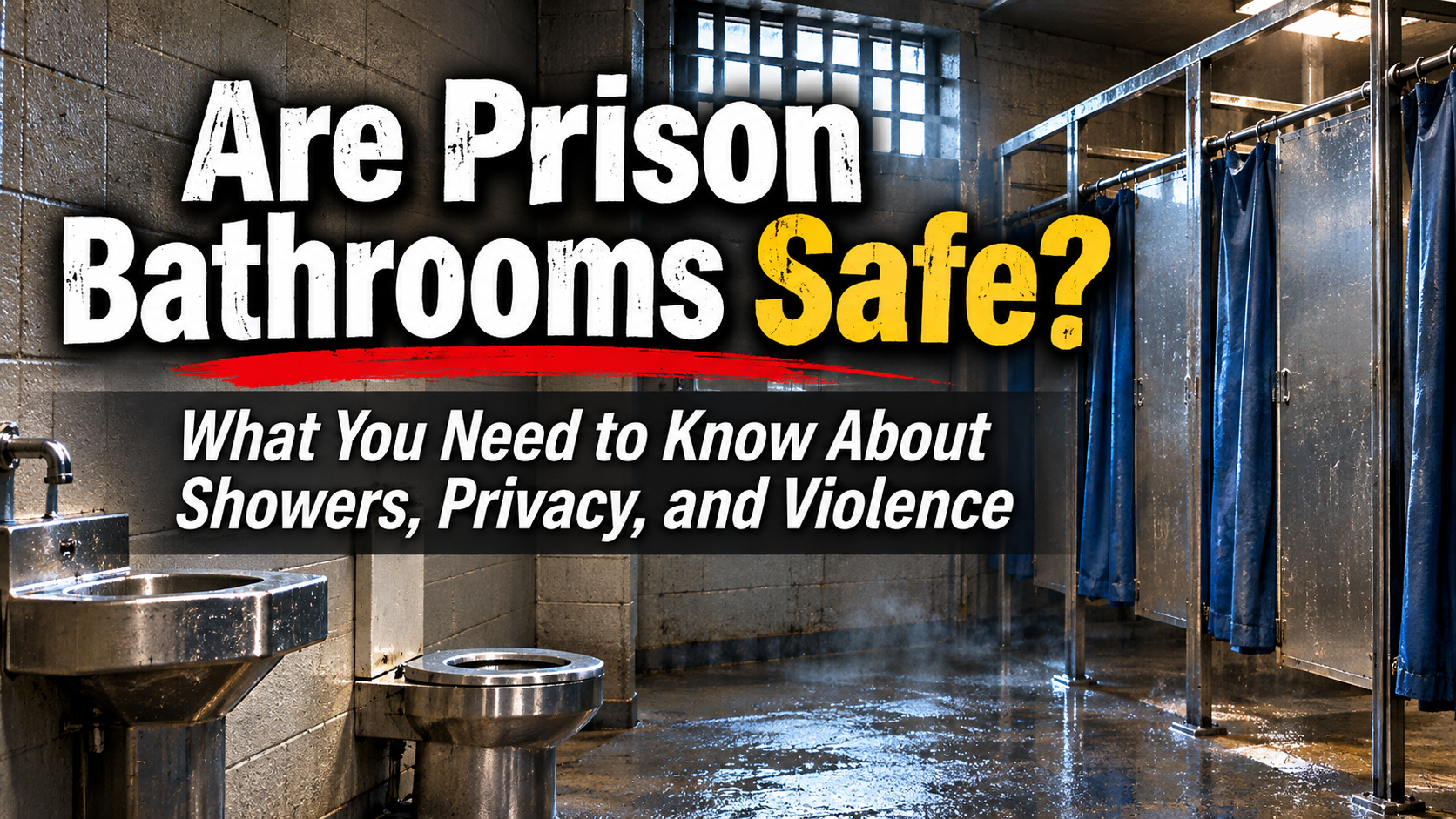
There’s no more private part of our daily lives than what happens in the bathroom. We take for granted that we can close a door, use the toilet, take a shower, and go about our business without worrying about who might be watching or what might happen.
Prison changes all of that.
One of the most common questions I’ve been asked about prison life concerns bathrooms and showers. Do prisoners have privacy? Are there cameras? Do they have to shower together? Are the bathrooms clean?
But there’s another question that defendants and their families should be asking: Are prison bathrooms safe?
After spending years inside federal and state prisons, I can tell you that prison bathrooms are about much more than toilets and showers. They are places where prisoners gather, use drugs, have sex, settle disputes, and sometimes fight. They can also be particularly dangerous for people who are vulnerable because of their charges, reputation, sexual orientation, gender identity, or other circumstances.
That doesn’t mean every prison bathroom is dangerous or that everyone entering one will be assaulted. It means understanding how these areas operate is an important part of preparing for incarceration.
Here are five things you need to know about prison bathrooms and showers, including some things most prison consultants probably won’t tell you.
1. Are Prison Bathrooms Safe?
The short answer is that it depends on the institution, the people using the bathroom, and the circumstances.
Prison bathrooms are unusual places. They are among the few areas in a correctional facility where prisoners can have some privacy from staff surveillance. That privacy serves an obvious purpose, but it also creates opportunities for misconduct.
I’ve seen plenty of things happen in prison bathrooms that would surprise someone who has never been incarcerated.
People use drugs in toilet stalls. They have sex in shower stalls. They fight, work out, give haircuts, cook food, wash clothes, and conduct all kinds of business that has little to do with using the bathroom.
In some prisons, the bathroom becomes a gathering place. People congregate there because they can get away from the constant observation that exists elsewhere in the institution.
This creates an important distinction between privacy and safety.
A bathroom might offer privacy from correctional officers without offering much protection from other prisoners.
Are there cameras in prison bathrooms?
In the federal prisons where I’ve been housed, cameras generally did not monitor the actual toilet and shower areas. Cameras may cover hallways, entrances, and other common areas, but the places where prisoners undress or use the toilet are ordinarily shielded from direct camera observation.
That doesn’t mean staff cannot enter, conduct inspections, or respond to emergencies. It means the activities taking place inside may not be visible to officers monitoring security cameras.
Federal privacy standards also place restrictions on staff viewing prisoners while they shower, use the toilet, or change clothes. Those protections have to be balanced against institutional security needs.
For a vulnerable prisoner, this lack of direct observation can be a legitimate concern.
A confrontation that begins inside a bathroom may develop before staff realize anything is happening.
Why some prisoners wear boots to the shower
One practice I’ve witnessed illustrates how seriously some prisoners take bathroom safety.
It’s not unusual to see someone walking into the shower wearing boots rather than shower sandals. Prisoners sometimes call this being strapped up.
The idea is simple: if a fight breaks out, boots provide better footing and protection than wet sandals.
That doesn’t mean wearing boots is necessary or appropriate for everyone. But it tells you something about how certain prisoners perceive the risks.
For someone entering prison for the first time, the lesson isn’t to prepare for a fight. It’s to understand the environment and avoid unnecessary confrontations.
2. How Much Privacy Do Prisoners Have When Using Toilets and Showers?
Privacy varies considerably between prisons, and the differences can be surprising.
In my experience, lower-security prisons sometimes provide less bathroom privacy than higher-security institutions.
At many medium- and high-security federal prisons, prisoners live in cells equipped with a toilet and sink. The cell has a door, and although there may be a window through which staff can observe the interior, a prisoner generally has more separation from other inmates when using the toilet.
In some institutions, prisoners use an informal signal called a flag. They place a piece of toilet paper in the door jamb to let others know the toilet is occupied.
At lower-security prisons, prisoners may live in dormitories or rooms without individual toilets. They use common bathrooms shared by dozens of people.
I’ve seen everything from conventional toilet stalls with doors to toilets separated by short cinderblock partitions only about 40 inches high.
You might have some privacy while sitting down, but not much.
Are federal prison showers private?
Federal prisons generally provide shower stalls offering at least some visual separation, often through partial doors or curtains.
The amount of privacy varies by institution.
Some showers have curtains that provide reasonable coverage. Others have short doors or arrangements that leave portions of the body visible.
The conditions can also differ between older and newer facilities.
In the federal institutions where I’ve been housed, shower privacy was generally better than what I experienced in Florida state prisons.
Florida state prison showers can be very different
During my time in Florida’s state prison system, I encountered communal showers that were completely open.
There were no individual stalls or curtains providing privacy.
Depending on the building’s layout, prisoners could be seen showering from large portions of the housing area. In one facility, even staff working in an office area, including female staff, had a view of the showers.
That is a very different environment from a federal prison shower stall with a curtain.
Federal and state correctional systems should not be treated as though they all operate the same way.
The type of facility, its age, its security level, and its physical layout can make an enormous difference.
What about transgender, gay, and other vulnerable prisoners?
Bathroom and shower privacy can present particular concerns for transgender prisoners, gay prisoners, people with sex-offense convictions, and others who may face harassment or targeting.
I’ve personally seen institutions make accommodations for transgender or gay prisoners by allowing them to shower separately when ordinary shower arrangements did not provide adequate privacy.
These accommodations were not necessarily uniform. Much depended on the institution and its administration.
Federal policies concerning transgender prisoners have changed significantly since January 2025, and some of those changes have been challenged in federal court. The BOP issued a new policy in February 2026, but court orders have continued to affect how certain accommodations must be handled.
Importantly, the Prison Rape Elimination Act (PREA) standards include a provision requiring that transgender and intersex prisoners have an opportunity to shower separately from other prisoners.
That is not the same as guaranteeing a private shower stall at every institution or eliminating all safety concerns.
Anyone facing a specific privacy or safety problem should determine what protections apply under current policy, applicable court orders, and the circumstances at that institution.
Privacy is not a luxury when someone is vulnerable to harassment or assault. It can be an important safety issue.
3. Prison Bathrooms Are Built for Security, Not Comfort
If you’ve never seen the inside of a prison bathroom, you might be surprised by how basic the fixtures are.
County jails and federal detention centers commonly use stainless-steel toilet-and-sink combinations.
These fixtures are designed to be durable, difficult to damage, and relatively easy to maintain.
They are also uncomfortable and inconvenient.
I’ve used fixtures where the sink was little more than a small basin mounted above the toilet. You pressed a button, received a short flow of water, and waited for the mechanism to reset.
The water was usually cold.
The mirrors were sometimes made of polished metal rather than glass. They were practically useless if you wanted to shave or see your face clearly.
Longer-term federal prisons may have more conventional fixtures, including porcelain sinks and toilets, regular faucets, and mirrors.
But don’t expect anything resembling a bathroom at home.
Do prisoners get hot showers?
Generally, yes. Federal prisons ordinarily provide heated water for showers, although the temperature, water pressure, and reliability can vary.
I’ve experienced showers where it took so long for the hot water to arrive that the allotted shower time was nearly over.
At the Metropolitan Detention Center in Brooklyn, I encountered five-minute shower timers. Sometimes that wasn’t even enough time to get properly warm water.
I’ve also seen toilets with flushing restrictions.
At USP Atlanta, I encountered toilets that permitted three flushes before requiring a ten-minute wait.
These arrangements were not universal throughout the BOP, but they demonstrate how much everyday conditions can vary.
For someone preparing to enter prison, these details might seem minor. After several months of living with them, they become part of daily life.
And when someone has medical needs, mobility limitations, or heightened safety concerns, access to a usable bathroom or shower can become much more significant.
4. You Need to Bring Your Own Bathroom Supplies
One of the first things people discover in prison is that they cannot assume the bathroom will contain the supplies they’re accustomed to finding in a public restroom.
Depending on the institution, you may need to bring your own toilet paper, soap, towel, washcloth, and other personal items.
In many federal prisons, prisoners receive basic hygiene supplies, but the quantity and availability can vary.
Additional supplies are generally available through the commissary, subject to institutional rules and purchasing limits.
When I was incarcerated, I routinely carried what I needed in a small bag.
You quickly learn not to depend on finding soap or paper towels waiting beside the sink.
Never go barefoot in a prison shower
This is one piece of advice I would give almost anyone entering prison.
Wear shower shoes! These are cheap sandals they sell on commissary. When you get to your first federal prison, there are usually groups that give shower shoes (or “slides” as they are commonly called) to newcomers. It might even be part of a care package with some soap and other hygiene items. Don’t be afraid to ask other prisoners if this is available when you arrive at a prison.
Prison showers are shared by large numbers of people. Even when they appear clean, they can expose users to fungi and other organisms associated with communal wet surfaces.
A pair of shower sandals is one of the simplest personal hygiene precautions available.
I’ve seen prisoners enter showers wearing everything from sandals to work boots, but going barefoot is something I strongly discourage.
A practical trick for carrying soap
Here’s something I learned from experience.
Instead of using a conventional soap dish, I used an empty peanut butter jar.
A bar of soap and a razor could fit inside, and the lid sealed tightly enough to prevent soap residue from leaking throughout my bag.
It wasn’t fancy, but it worked.
Some prisoners also bring a chair or other permitted item into the shower area to keep clean clothing off wet surfaces. Others hang their clothes over a shower door or curtain.
These arrangements depend on what the institution permits.
The point is that even something as ordinary as taking a shower requires planning.
5. Bathroom Etiquette Can Prevent Serious Problems
One of the most overlooked parts of prison preparation is learning the unwritten rules.
Every prison has formal regulations, but prisoners also develop their own expectations about how shared spaces should be used.
Bathrooms are no exception.
Violating these expectations can create unnecessary confrontations, even when the person involved has no intention of being disrespectful.
Keep shared spaces clean
Contrary to what many people imagine, most prison bathrooms are remarkably clean.
The BOP uses prisoner orderlies to maintain housing units and common areas.
I’ve seen bathroom orderlies take considerable pride in their work. At one institution, the bathrooms were cleaned several times a day and pressure-washed weekly. They were spotless.
Part of the reason is that the prisoners responsible for cleaning the bathrooms also use them.
People generally don’t appreciate someone making a mess in a space they have to maintain.
Learn the rules about toilets and sinks
For example, prisoners generally expect people to use urinals when they’re available rather than standing at a toilet and leaving a mess.
If you must use a toilet while standing, make sure you leave it clean.
Courtesy flushing is another common practice.
Flushing during use helps control odors and noise, although some institutions have water-saving devices that limit how frequently a toilet can be flushed.
Shared sinks can also become a source of conflict.
In a cell with a roommate, don’t automatically assume it’s acceptable to spit toothpaste into the sink.
Some prisoners strongly object to that practice, especially when the same sink is used for drinking water or washing.
I’ve seen arguments and fights begin over matters that would seem trivial outside prison.
Respect other people’s space
The most important lesson is to avoid inserting yourself into other people’s business.
If prisoners are gathering in the bathroom, arguing, or engaging in activities that have nothing to do with you, don’t assume you need to get involved.
Avoid confrontations, respect personal space, and understand that the expectations in one institution may differ from those in another.
At the same time, nobody should feel obligated to tolerate threats, sexual harassment, or assault simply because those behaviors occur in prison.
There is a difference between understanding prison culture and accepting victimization.
What Families Should Understand About Prison Bathroom Safety
For families, the idea of a loved one entering prison can be frightening.
Questions about showers and toilets may sound mundane, but sometimes they reflect much deeper concerns.
Will my son be safe? Will my daughter have privacy? What happens if someone threatens them? Will correctional officers intervene? Can a vulnerable prisoner request separate shower access?
These are reasonable questions.
And they deserve answers grounded in how prisons actually operate, not television portrayals or frightening stories designed to sell consulting services.
Not every prison bathroom is a dangerous place. Not every prisoner faces the same risks. And there are substantial differences between federal institutions, state prisons, and county jails.
But it’s equally misleading to pretend that prison bathrooms are simply ordinary restrooms with locked doors.
The lack of privacy, the absence of direct camera coverage in many toilet and shower areas, and the activities that sometimes occur there can create real safety concerns.
Understanding those conditions before entering prison is part of being prepared.
Preparing for Federal Prison Means Understanding the Details
I’ve spent more than 16 years working with sex-offense cases and other sensitive criminal matters, and I have firsthand experience living in federal and state prisons.
I’ve seen the differences between institutions, security levels, housing arrangements, and the way prisoners are treated in everyday situations.
That experience is central to the work I do through Facing Federal Prison.
I help defendants and their families understand what to expect in federal custody, including prison designation, classification, personal safety, protective custody, communication, and the unwritten rules that can make prison life more manageable.
For people with sex-offense convictions, high-profile cases, informant concerns, or other circumstances that may create additional risks, preparation can be particularly important.
The goal isn’t to frighten someone about going to prison. It’s to help them understand the environment they’re entering and make informed decisions before problems develop.
If you or someone you care about is preparing to enter federal prison and has concerns about personal safety, privacy, or housing, I can help you understand what to expect and prepare for the challenges ahead.
Schedule a strategy call with Facing Federal Prison to discuss your situation.

Dale Chappell prepares people in sensitive, high-profile, and high-stakes federal cases for prison. He works with clients, families, and attorneys during pretrial, throughout incarceration, and during the transition to halfway house placement, home confinement, and supervised release.
Dale brings more than 17 years of experience, firsthand knowledge of the federal prison system, and experience testifying at high-profile public hearings on prison and criminal justice issues. He helps clients protect their safety and privacy, avoid decisions that can follow them throughout their sentences, and prepare for the strongest possible outcome at every stage.
Dale has written nearly 600 published articles on federal prison, post-conviction, and criminal justice issues.
Have questions?
Contact Dale directly at dale@facingfederalprison.com.


Leave a Reply