
WHEN YOUR CASE REQUIRES MORE THAN ORDINARY PRISON CONSULTING
Specialized guidance for clients and their attorneys in sensitive, high-profile, and complex federal cases.

You may not have heard of me because I don’t try to be everything to everyone. I work with defendants, families, and defense attorneys facing sensitive, high-profile, and complex federal prison cases that require specialized experience and practical insight.
Attorneys understand the law. My role is to address the prison issues that arise before sentencing and continue long after it. That includes preparing clients with sensitive offenses to enter prison safely, identifying PSR language that could affect designation, understanding SOMP and sex offender treatment issues, and addressing protective custody concerns before they become real problems.
Not every federal prison case requires specialized consulting. But when the stakes are unusually high, ordinary prison consulting isn’t enough.
Connect with me:
How I Help
Prison Strategy for Sensitive and High-Profile Cases
Preparing for federal prison involves dozens of decisions that can affect a client’s safety and daily life. I help clients and defense attorneys evaluate protective custody options, review PSR language for potential prison implications, understand SOMP and sex offender treatment requirements, prepare for designation, and develop a plan for entering federal prison safely and with realistic expectations.
Family Guidance and Crisis Planning
Families often face the same uncertainty as the defendant. I help families understand what to expect before sentencing, during incarceration, and after release, including preparing for designation, responding to prison emergencies, and separating fact from rumor during one of the most stressful periods of their lives.
Reentry and Supervised-Release Strategy
Release from prison is the beginning of a new phase, not the end of the process. I help clients pursue early termination of supervised release, understand and comply with release conditions, address registration-related concerns, overcome housing and employment obstacles, and develop practical strategies for long-term success after federal custody.
Federal Post-Conviction Consulting
Federal post-conviction work often requires more than filing motions. I assist clients and attorneys with case organization, issue identification, legal research support, and strategic preparation for post-conviction litigation. My role is to help ensure that important issues are identified, organized, and presented as effectively as possible.
Latest blog posts
In-Depth Insights
Practical analysis on federal custody, sentencing, post-conviction trends, and supervised-release issues, written for defendants, families, and attorneys who want clear, accurate information.
-

The AEDPA: A Forgotten Catalyst in Mass Incarceration
When we talk about things that fuel mass incarceration, the Antiterrorism and Effective Death Penalty Act (“AEDPA”) is rarely considered as one of the causes for the over-incarceration of U.S. residents. But take a closer look, and you’ll see that the AEDPA has played an integral role in keeping the nation’s prisons full and the…
-

How Poorly Worded Claims Kill a Post-Conviction Case Before It Starts
In federal post-conviction litigation, attention to detail matters. A single word or misplaced phrase can decide whether a claim is heard or dismissed. Once a court mislabels a claim, correcting that mistake can be nearly impossible. That is exactly what happened in Baker v. United States, 2025 U.S. App. LEXIS 22792 (6th Cir. Sep. 2,…
-

How Pretrial Detention Extracts Guilty Pleas
Jail Is Leverage: How Pretrial Detention Extracts Guilty Pleas (and Why “Public Safety” Is a Punchline) If you’ve never sat in a jail cell, it’s hard to grasp how quickly time there changes everything. At first, you might be telling yourself: “I’ll fight this. I’m innocent. I’ll get my day in court.” But then the…
-

Why Competent Post-Conviction Help is Crucial
Federal habeas corpus litigation is one of the most complex areas of postconviction law. Unlike direct appeals or state postconviction petitions, federal habeas is governed by the Antiterrorism and Effective Death Penalty Act of 1996 (AEDPA), which imposes strict deadlines and procedural bars. Many meritorious claims are never reviewed because petitioners miss the one-year filing…
-
New Hampshire Department of Corrections Faces $10.8 Million Overtime Budget Overrun
The New Hampshire Department of Corrections (DOC) has exceeded its fiscal year 2025 overtime budget by $10.8 million, prompting a formal request to the state’s Executive Council to reallocate funds within the department to cover the gap. The request was reviewed by the five-member Executive Council on Wednesday. While the council approved the reallocation, members…
-

Why You Need to Help Your Loved One Prepare for Release Long Before the BOP Does
If you have a family member in federal prison, now is the time to help them prepare for release—even if it feels like they have a long way to go. Don’t wait until they’re “six months out.” That’s what the Bureau of Prisons (BOP) tells inmates, but it’s misleading and dangerous. The BOP’s own policies…
-

South Carolina Lawmaker Charged with Sex Crimes
On June 11, 2025, South Carolina state representative RJ May was arrested and charged in federal court with 10 counts of distributing child sexual abuse material (CSAM) (find the indictment here). He was sentenced to just over 17 years in prison January 14, 2026. While the headlines focus on the political fallout, this case provides…
-
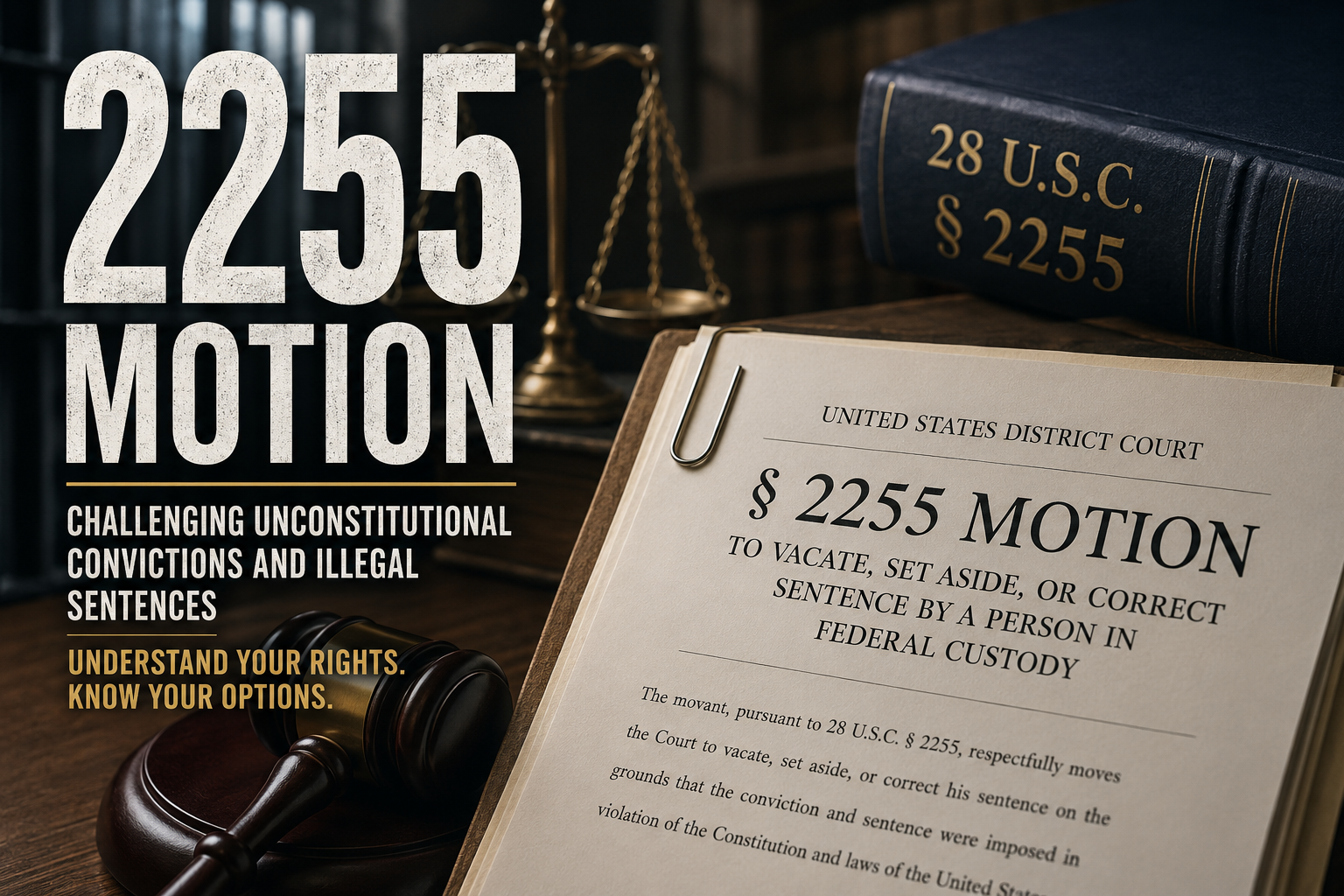
Understanding the 2255 Motion
A Motion to Vacate Judgment Under 28 U.S.C. § 2255 Most people think a federal criminal case ends after sentencing and appeal. It doesn’t. After the appeal process is over, a federal prisoner may still be able to challenge the conviction or sentence through what’s called a motion under 28 U.S.C. § 2255, usually shortened…
-

What to Expect in Federal Prison
Entering federal prison can be overwhelming, especially without preparation. From orientation to daily routines, the experience varies depending on security level and facility policies. Understanding the Bureau of Prisons (BOP) classification system can help inmates anticipate housing, work assignments, and potential program eligibility. Adjusting to prison life takes both mental and emotional preparation. Learning what…